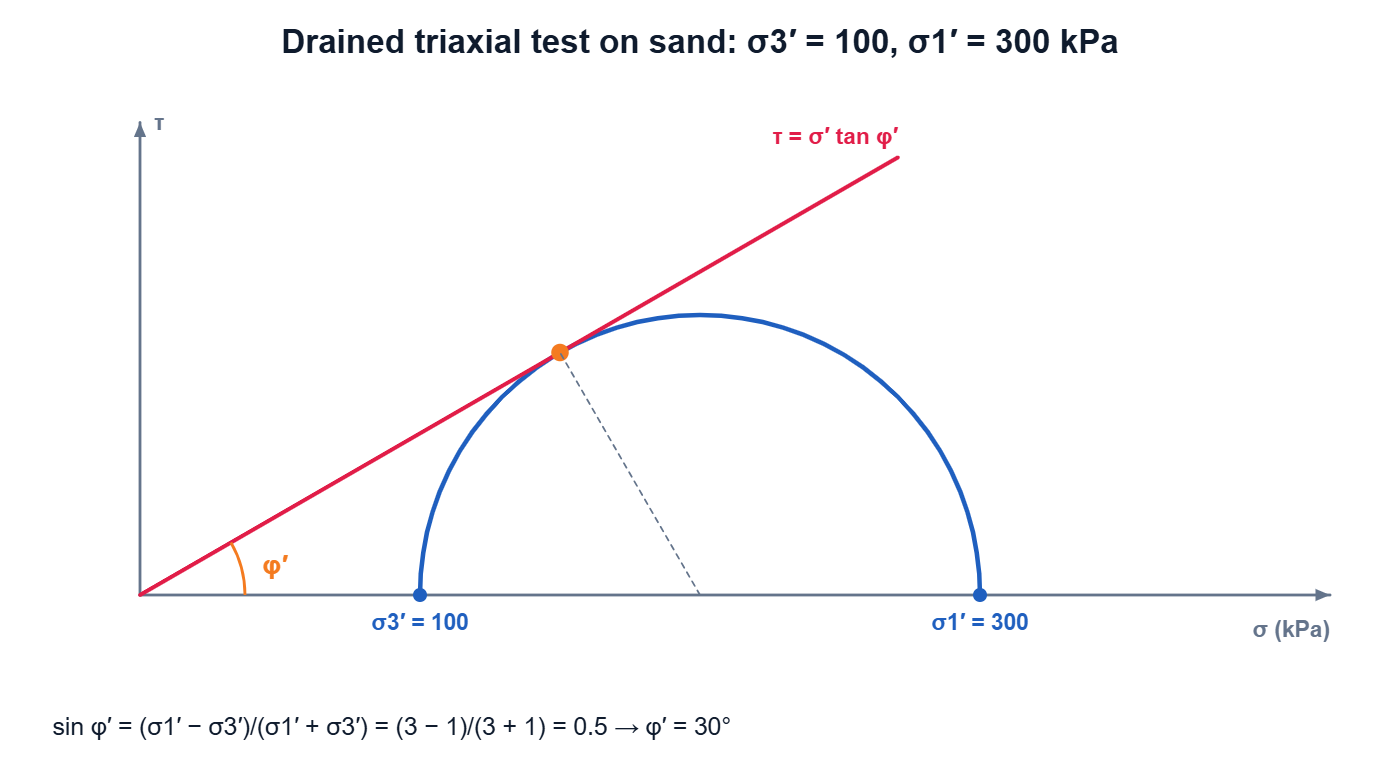
A drained triaxial test was performed on a representative sand specimen with σ3′ = 100 kPa and σ1′/σ3′ = 3 at failure. The effective friction angle is
- A34°
- B35°
- C30°Correct
- D27°
Solution
Concept
Effective Friction Angle of Sand
Formula
sin(ϕ') = (σ1' - σ3') / (σ1' + σ3')
Step-by-step solution
1. Use the ratio formula: sin(ϕ') = (σ1'/σ3' - 1) / (σ1'/σ3' + 1) 2. Substitute σ1'/σ3' = 3: sin(ϕ') = (3 - 1) / (3 + 1) = 2/4 = 0.5 3. Find angle: ϕ' = sin⁻¹(0.5) = 30°
Explanation
For sand (where cohesion c' = 0), the relationship between principal effective stresses at failure is sin(ϕ') = (σ1' - σ3') / (σ1' + σ3'). Dividing the numerator and denominator by σ3' gives sin(ϕ') = (σ1'/σ3' - 1) / (σ1'/σ3' + 1). Substituting σ1'/σ3' = 3 gives sin(ϕ') = (3 - 1) / (3 + 1) = 2/4 = 0.5, which corresponds to an effective friction angle ϕ' = 30°.
Shortcut
Use the direct ratio shortcut: sin(ϕ') = (r - 1) / (r + 1), where r = σ1'/σ3'. For a ratio of 3, sin(ϕ') = 2 / 4 = 0.5, which directly corresponds to ϕ' = 30°. Memorize that a stress ratio of 3 always gives a 30° friction angle in sand.
Common mistake
A common mistake is using tan(ϕ') instead of sin(ϕ') in the stress relationship formula at failure, or incorrectly setting up the relation as tan²(45° + ϕ'/2) and making algebraic errors when solving for ϕ'.
Correct answer: C) 30°