A fixed beam subjected to a central point load against gravity, the number of points of contraflexure and their positions respectively are
- A1 and L/2 from centre of the beam
- B2 and L/3 from both the supports
- C2 and L/4 from centre of the beamCorrect
- D3 and L/4 from both the supports and at centre of the beam
Solution
Concept
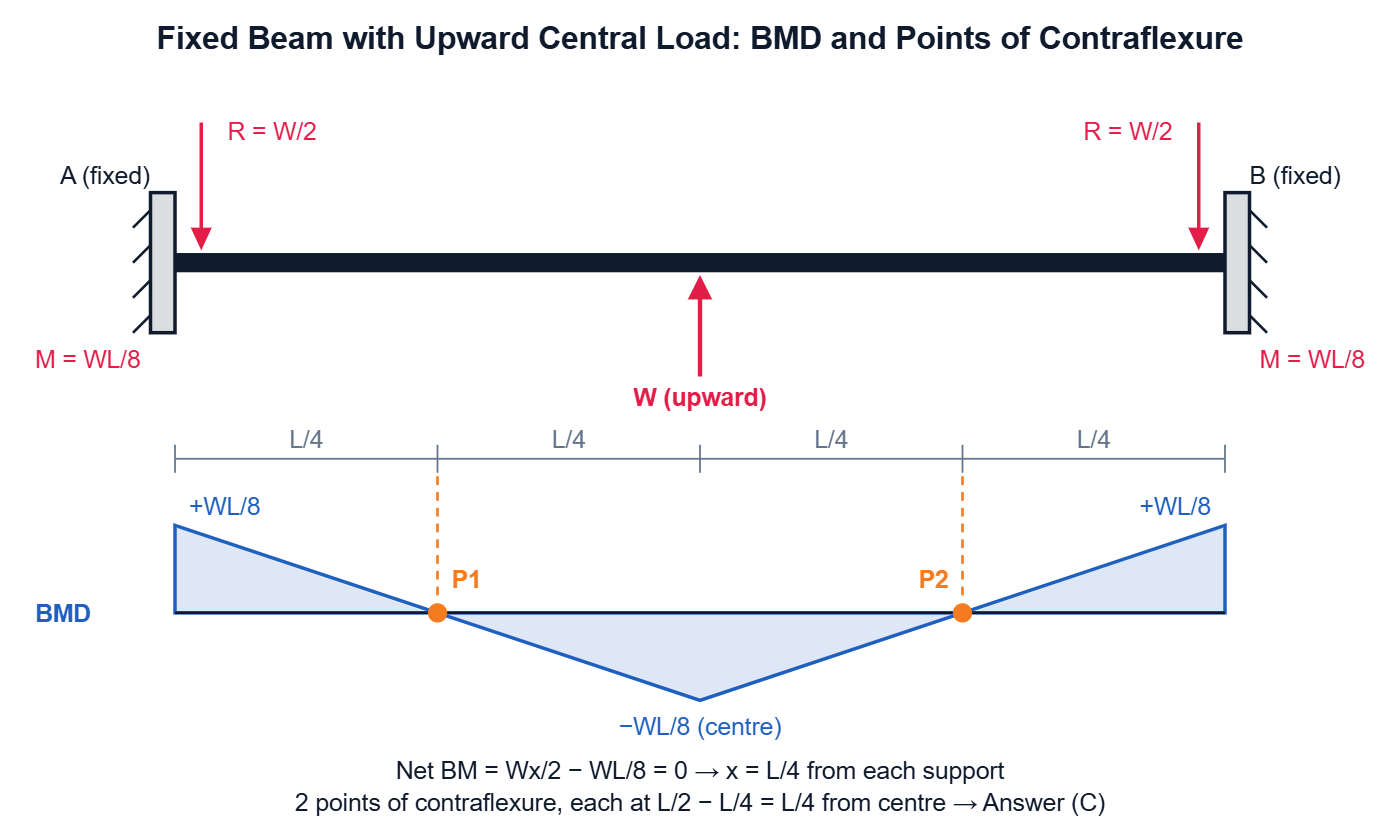
In a fixed beam with central point load W, end moments are WL/8 (hogging) and the centre moment is WL/8 (sagging), so BM changes sign twice.
Formula
MA = MB = WL/8; Mcentre = WL/4 - WL/8 = WL/8
Step-by-step solution
1. Fixing end moments = WL/8 each. 2. Free BM at distance x from A (x ≤ L/2) = Wx/2. 3. Net BM = Wx/2 - WL/8. 4. Put net BM = 0: Wx/2 = WL/8, so x = L/4. 5. By symmetry, the second point is at L/4 from B. 6. Distance from centre = L/2 - L/4 = L/4. 7. So there are 2 points, each at L/4 from the centre.
Explanation
The BM diagram of a fixed beam with central load is hogging near the supports and sagging at the centre. It becomes zero at L/4 from each support, which is also L/4 from the centre. The load acting upward (against gravity) only reverses the signs of all moments. The positions of the zero points stay the same.
Why the other options are wrong
A: There are two sign changes, not one. B: The points are at L/4, not L/3, from the supports. D: The BM is maximum (WL/8) at the centre, not zero, so there are only 2 points.
Shortcut
Fixed beam with central point load: 2 points of contraflexure at L/4 from each end (also L/4 from centre).
Common mistake
Thinking that load direction changes the positions, or confusing this with the UDL case (0.211L from the ends).
Correct answer: C) 2 and L/4 from centre of the beam