A flat plate 1.5 m × 1.5 m moves at 45 km/hour in stationary air of specific weight 11.3 N/m³. If the coefficient of lift is 0.75, then what is the lift force?
- A120.4 N
- B151.9 NCorrect
- C180.4 N
- D225.9 N
Solution
Concept
Lift force on a body in a moving fluid depends on the lift coefficient, the area, the fluid density and the square of the velocity.
Formula
FL = CL × A × ρ × V2 / 2, ρ = w / g
Step-by-step solution
1. Density of air: ρ = w/g = 11.3/9.81 = 1.152 kg/m³ 2. Velocity: V = 45 km/h = 45 × 1000/3600 = 12.5 m/s 3. Area: A = 1.5 × 1.5 = 2.25 m² 4. FL = CL × A × ρ × V2 / 2 = 0.75 × 2.25 × 1.152 × 12.52 / 2 5. FL = 0.75 × 2.25 × 1.152 × 156.25 / 2 = 151.9 N
Explanation
Lift force is found from the lift equation FL = CL A ρ V2/2. First change the specific weight into density by dividing by g, and change the speed from km/h to m/s. Putting in the values gives about 151.9 N.
Why the other options are wrong
A (120.4 N): wrong value, maybe from a calculation slip. C (180.4 N): this is close to ρV2 (about 180), so the area, CL and 1/2 were not applied correctly. D (225.9 N): wrong value, likely from using specific weight or the speed wrongly.
Shortcut
Divide km/h by 3.6 to get m/s. Then FL = 0.5 × 0.75 × 2.25 × (11.3/9.81) × 12.52.
Common mistake
Using specific weight (11.3 N/m³) directly as density, or not changing km/h to m/s.
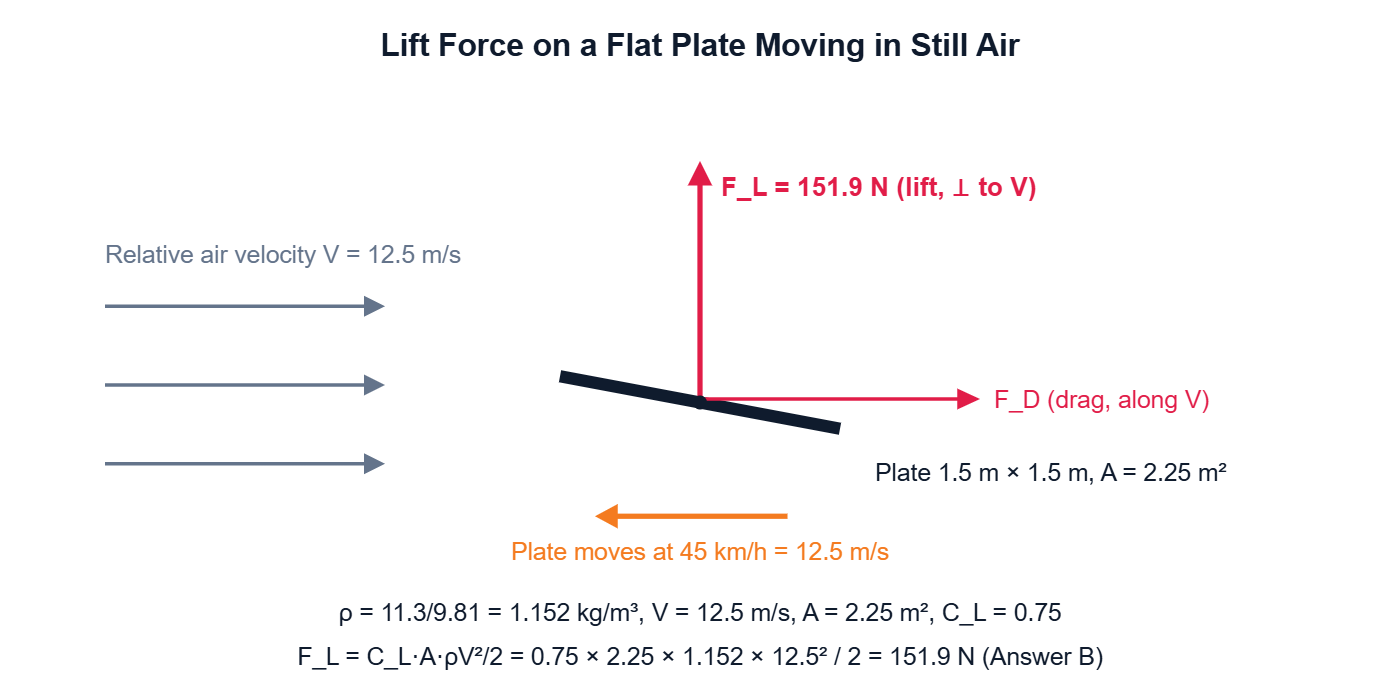
Correct answer: B) 151.9 N