A Hydraulic Jump occurs in an open channel when the flow changes from
- ASupercritical to SubcriticalCorrect
- BSubcritical to Supercritical
- CSteady to Unsteady
- DUniform to Non-uniform
Solution
Concept
Hydraulic Jump
Formula
y2/y1 = 0.5 × (√(1 + 8·Fr12) - 1) and ΔE = (y2 - y1)3 / (4 × y1 × y2)
Step-by-step solution
1. Identify the definition and physical behavior of a hydraulic jump in open channel flow. 2. Recall that a hydraulic jump occurs when fast, high-velocity supercritical flow abruptly transitions into a slower, deeper subcritical flow. 3. Compare this behavior with the given choices and select Option (a) as the correct answer.
Explanation
A hydraulic jump happens when fast, high-energy water (supercritical flow) suddenly slows down and transforms into slower, deeper water (subcritical flow). This rapid change causes a sudden rise in the water surface and creates turbulence that dissipates energy.
Shortcut
To remember the flow transition in a hydraulic jump, use the trick "Jumping from SUPER to SUB": - Supercritical (fast & shallow flow) to Subcritical (slow & deep flow) - Memory Trick: Water has "SUPER" high energy/speed before it takes a "JUMP" up in depth, settling down into a "SUB" (slower) state.
Common mistake
A common mistake is selecting Option B by confusing the flow states and incorrectly assuming a hydraulic jump occurs from subcritical to supercritical flow. Students often mix up low depth/high velocity (supercritical) with high depth/low velocity (subcritical). Another frequent error is choosing Option D by confusing the type of flow transition (varied flow) with the energy state change required for a jump to occur.
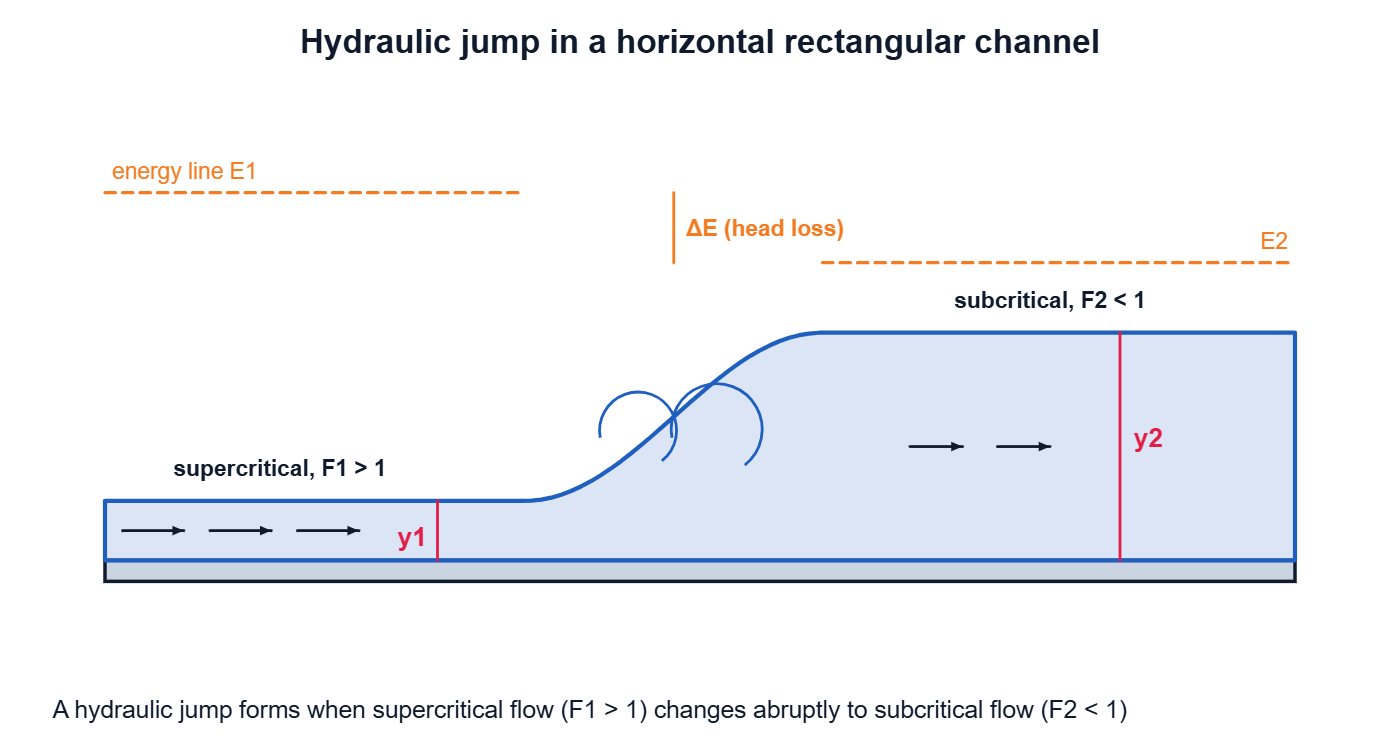
Correct answer: A) Supercritical to Subcritical