A sewage has a suspended solid contents as 250 mg/litre. The sedimentation tank removes 55% of the suspended solids and the water content of the sludge is 95%. What is the quantity of sludge produced after treating 6.5 × 10⁶ litres of sewage? (Assume the specific gravity of sludge as 1.0)
- A11.875 cu.m
- B14.275 cu.m
- C17.875 cu.mCorrect
- D20.275 cu.m
Solution
Concept
Dry solids removed in the tank are only a small part of the wet sludge. Sludge volume = dry solids / (solid fraction × density).
Formula
Ws = SS × η × V; Vsludge = Ws / ((1 - p) × G × ρw)
Step-by-step solution
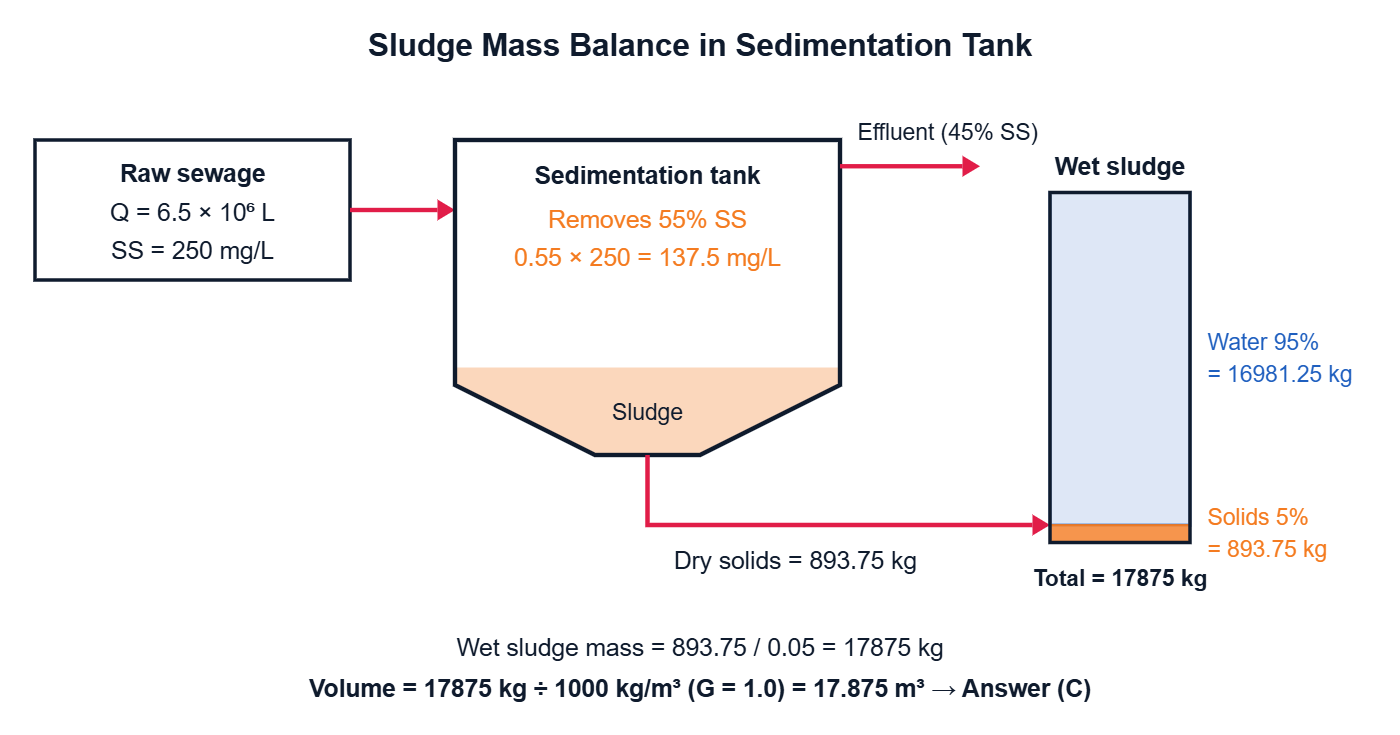
1. SS removed per litre = 0.55 × 250 = 137.5 mg/L 2. Dry solids removed = 137.5 mg/L × 6.5 × 10⁶ L = 893.75 × 10⁶ mg = 893.75 kg 3. Water content = 95%, so solids = 5% of sludge mass 4. Wet sludge mass = 893.75 / 0.05 = 17875 kg 5. With G = 1.0, density = 1000 kg/m³ 6. Sludge volume = 17875 / 1000 = 17.875 m³
Explanation
The tank removes 55% of 250 mg/L of suspended solids, which gives about 893.75 kg of dry solids. These solids are only 5% of the wet sludge because the sludge has 95% water, so the wet sludge mass is 17875 kg. With specific gravity 1.0, this is 17.875 m³.
Why the other options are wrong
A (11.875 m³), B (14.275 m³) and D (20.275 m³) do not match the correct calculation of removed solids divided by the 5% solid fraction.
Shortcut
Volume (m³) = 250 × 0.55 × 6.5 / 0.05 / 1000 = 17.875
Common mistake
Dividing dry solids by 0.95 instead of 0.05, or forgetting the 55% removal efficiency.
Correct answer: C) 17.875 cu.m