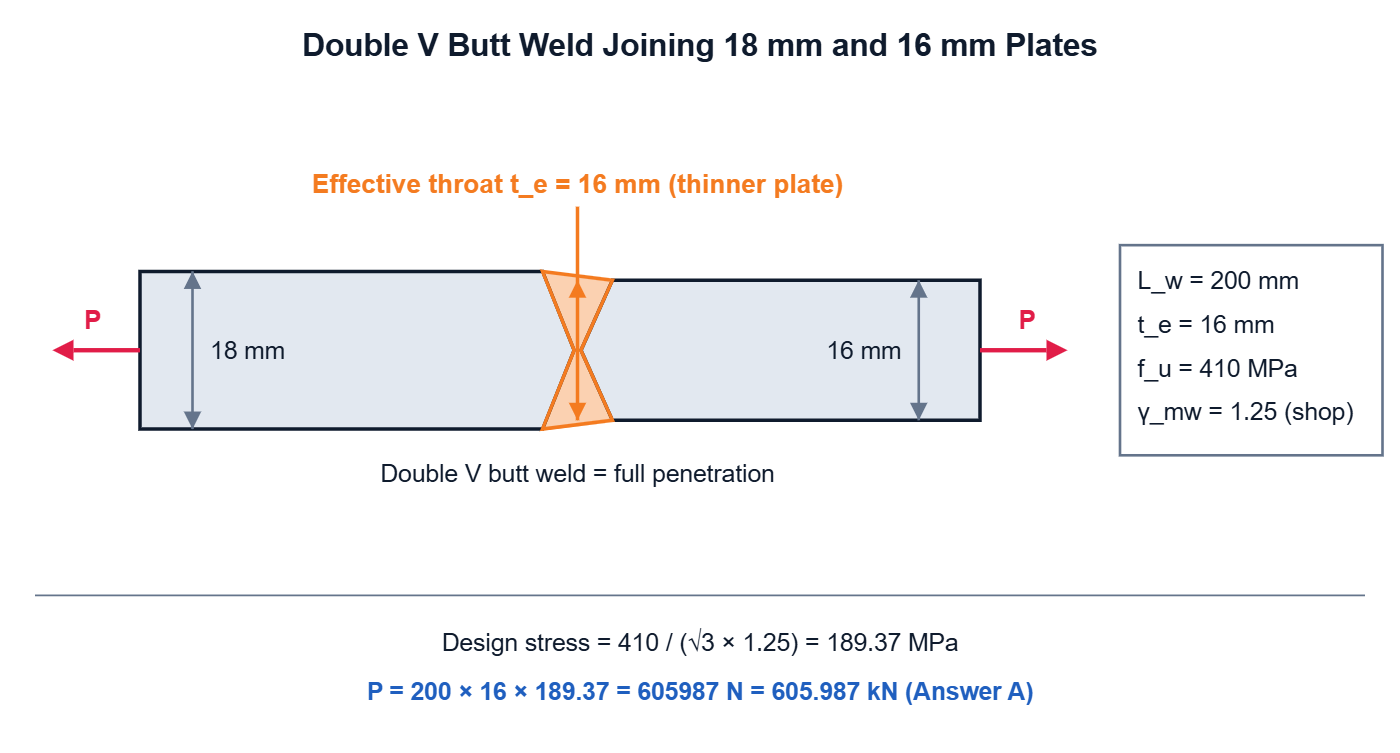
An 18 mm thick plate is joined to a 16 mm plate by 200 mm long (effective) butt weld. What is the strength of joint if a double V butt weld is used? (Assume that Fe410 grade plates and shop welds are used)
- A605.987 kNCorrect
- B378.742 kN
- C467.535 kN
- D478.348 kN
Solution
Concept
For a full penetration butt weld, the effective throat is the thickness of the thinner plate, and design strength is throat area × design stress of weld.
Formula
P = Lw × te × fu / (√3 × γmw)
Step-by-step solution
1. Double V butt weld gives full penetration, so te = thinner plate = 16 mm. 2. Effective length Lw = 200 mm. 3. Fe410: fu = 410 MPa. Shop weld: γmw = 1.25. 4. Design stress = 410 / (√3 × 1.25) = 189.37 MPa. 5. P = 200 × 16 × 189.37 = 605987 N = 605.987 kN.
Explanation
In a double V butt weld the full thickness is welded, so the throat is the thinner plate thickness (16 mm). Weld strength = throat area × fu/(√3 γmw). This gives about 606 kN.
Why the other options are wrong
B, C and D do not match te = 16 mm with fu/(√3 × 1.25). They come from a wrong throat, wrong partial safety factor, or wrong stress.
Shortcut
3200 mm² × 189.4 MPa ≈ 606 kN
Common mistake
Using the thicker plate (18 mm) as throat, or using γmw = 1.5, which is for field welds.
Correct answer: A) 605.987 kN