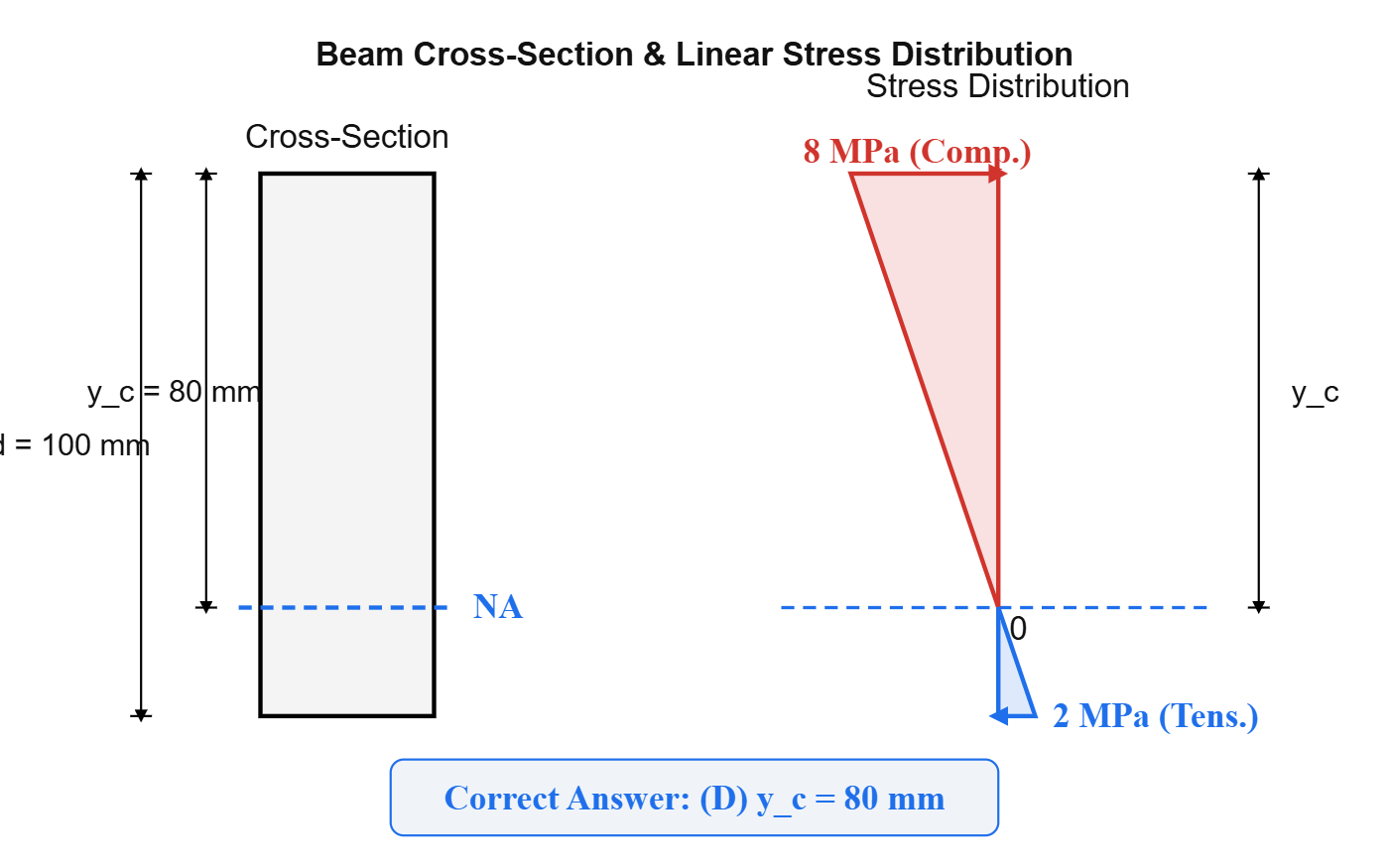
At a cross-section of the beam, the maximum compressive stress at the top is 8 MPa and the maximum tensile stress at the bottom is 2 MPa. If the depth of the cross-section is 100 mm, then the depth of the neutral axis from the top of the section will be
- A20 mm
- B40 mm
- C60 mm
- D80 mmCorrect
Solution
Concept
The neutral axis divides the cross-section into compression and tension zones, where the stresses vary linearly with depth according to Hooke's Law and pure bending theory.
Formula
σc / yc = σt / yt, where yc + yt = d
Step-by-step solution
1. Let yc be the depth of the neutral axis from the top fiber. 2. The depth of the neutral axis from the bottom fiber will be yt = d - yc = 100 - yc. 3. By similar triangles in stress distribution: σc / yc = σt / (100 - yc). 4. Substitute the given values: 8 / yc = 2 / (100 - yc). 5. Solve for yc: 8(100 - yc) = 2yc => 800 - 8yc = 2yc => 10yc = 800 => yc = 80 mm.
Explanation
From the bending stress distribution (Navier's formula), stress is directly proportional to the distance from the neutral axis (y). Using similar triangles or stress proportionality, the ratio of distances from the neutral axis to the top and bottom fibers is equal to the ratio of compressive and tensile stresses.
Correct answer: D) 80 mm