Consider the following statements related to lug angle: If the main member is an angle, 1.the strength of lug angles and fastener connecting lug angle to gusset plate should be at least 20% more than the force in outstanding leg. 2.the strength of the fastener connecting lug angle and main member should be at least 40% more than the force in outstanding leg. 3.the whole area of the member is net area less deduction for bolt holes. Which of the above statements are correct?
- A2 and 3 only
- B1 and 3 only
- C1 and 2 only
- D1, 2 and 3Correct
Solution
Concept
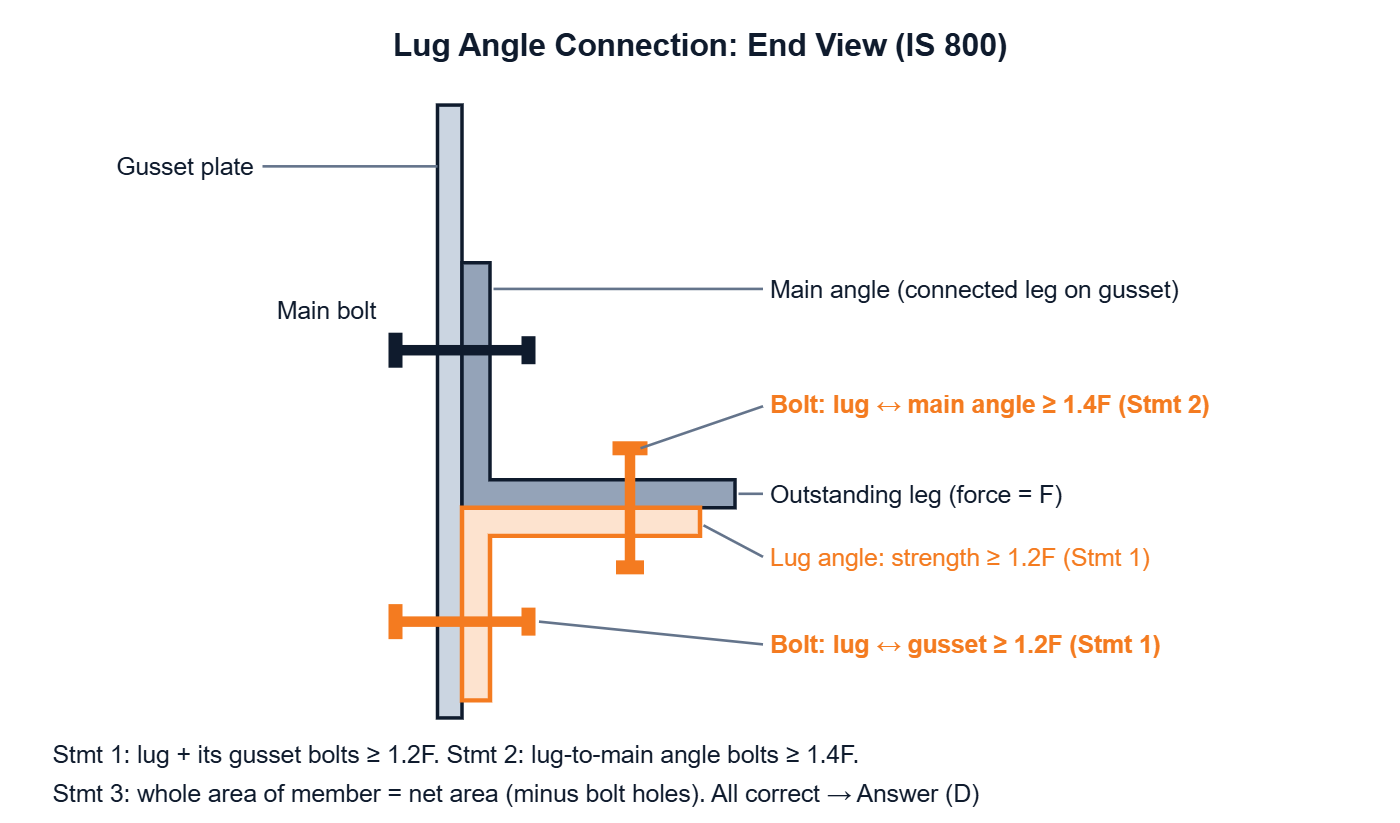
Lug angles help connect the outstanding leg of an angle. IS 800 asks for extra strength in the lug angle and its connections.
Step-by-step solution
1. A lug angle is a short angle. It connects the outstanding leg of the main angle to the gusset plate. 2. As per IS 800, the lug angle and its connection to the gusset must develop at least 20% more than the force in the outstanding leg. So statement 1 is correct. 3. The connection of the lug angle to the main angle must develop at least 40% more than that force. So statement 2 is correct. 4. When lug angles are used, the whole area of the member is taken as effective, i.e. net area after deducting bolt holes. So statement 3 is correct. 5. All three statements are correct. Answer is (D).
Explanation
Lug angles reduce shear lag because both legs of the main angle get connected. IS 800 needs 20% extra strength for the lug-to-gusset side and 40% extra for the lug-to-main-member side. With lug angles, the full net area (gross area minus holes) is taken as effective.
Why the other options are wrong
A misses the correct statement 1. B misses the correct statement 2. C misses the correct statement 3.
Shortcut
Remember: lug to gusset = 20% extra, lug to main member = 40% extra.
Common mistake
Swapping the 20% and 40% values between the two connections.
Correct answer: D) 1, 2 and 3