Consider the following statements related to maximum shear stress theory (Guest's theory): 1.This theory is well justified for ductile materials. 2.It gives accurate results for the state of stress of pure shear in which maximum amount of shear is developed. 3.The results of this theory differ from the experimental results for materials having large differences in elastic stress limits in tension and compression. Which of the above statements is/are NOT correct?
- A1 only
- B2 onlyCorrect
- C3 only
- D2 and 3 only
Solution
Concept
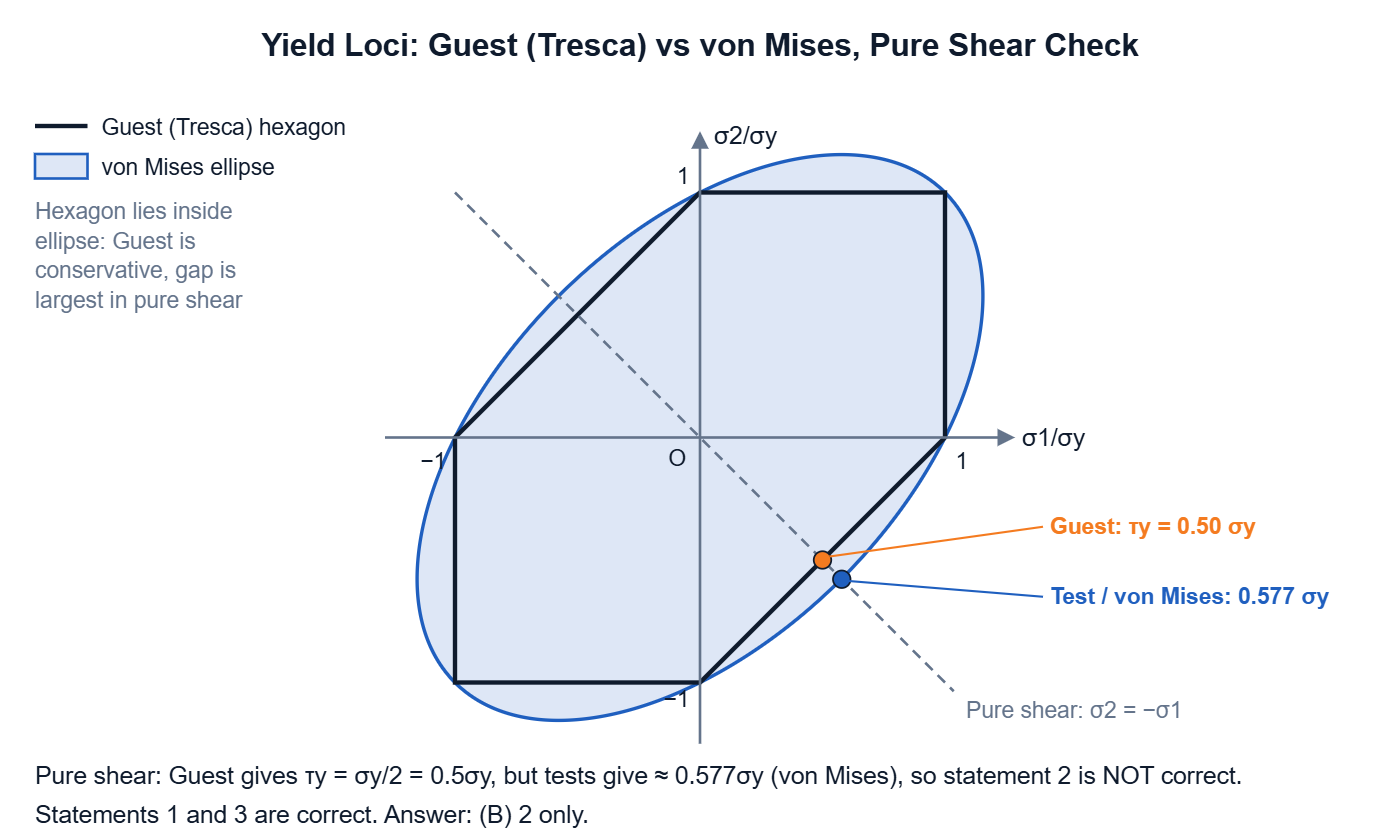
Guest's theory suits ductile materials, but it is not accurate for pure shear. It also assumes equal yield stress in tension and compression.
Formula
τmax = (σ1 − σ3)/2 ≤ σy/2
Step-by-step solution
1. Statement 1: Guest's theory is based on shear failure (yielding). Ductile materials fail by shear, so it is well justified. Correct. 2. Statement 2: In pure shear, this theory gives shear yield stress τy = 0.5σy. Experiments show about 0.577σy, which matches the von Mises theory. So this theory is not accurate for pure shear. NOT correct. 3. Statement 3: The theory assumes equal elastic limits in tension and compression. For materials where these limits differ a lot, its results differ from experiments. Correct. 4. Only statement 2 is NOT correct. Answer (B).
Explanation
Maximum shear stress theory works well for ductile materials. In pure shear it predicts τy = 0.5σy, but tests show about 0.577σy, so it is not accurate there. It also fails for materials with very different tension and compression limits, so statement 3 is a true statement.
Why the other options are wrong
A: Statement 1 is correct, because the theory suits ductile materials. C: Statement 3 is a correct statement, because the theory assumes equal tension and compression limits. D: Statement 3 is correct, so it should not be included.
Shortcut
For pure shear: Tresca gives 0.5σy, von Mises gives 0.577σy, and tests agree with von Mises.
Common mistake
Thinking the theory is exact for pure shear just because it is based on maximum shear stress.
Correct answer: B) 2 only