For a circular shaft subjected to pure torsion, the shear stress distribution across the section is
- AUniform throughout the entire cross-section.
- BMaximum at the center and zero at the outer surface.
- CZero at the center and increases linearly to a maximum at the outer surface.Correct
- DParabolic, with the maximum value at the neutral axis.
Solution
Concept
Shear Stress Distribution in Torsion
Step-by-step solution
1. Review the question regarding the shear stress distribution in a circular shaft under pure torsion. 2. Recall the torsion formula T/J = τ/r, which indicates that shear stress (τ) is directly proportional to the radial distance (r). 3. Note that at the center (r = 0), shear stress is zero, and as r increases, shear stress increases linearly to a maximum at the outer surface (r = R). 4. Match this linear relationship with the choices and select Option (c) as the correct answer.
Explanation
In pure torsion, the shear stress in a circular shaft is directly proportional to its distance from the center. Therefore, the shear stress is zero at the central axis and increases linearly to reach its maximum value at the outer surface.
Common mistake
A common mistake is selecting option D by confusing the shear stress distribution in pure torsion (which is linear from zero at the center to maximum at the surface) with the shear stress distribution in beam bending (which is parabolic with a maximum at the neutral axis). Another frequent error is selecting option B by confusing shear stress with bending stress or misremembering where the maximum stress occurs.
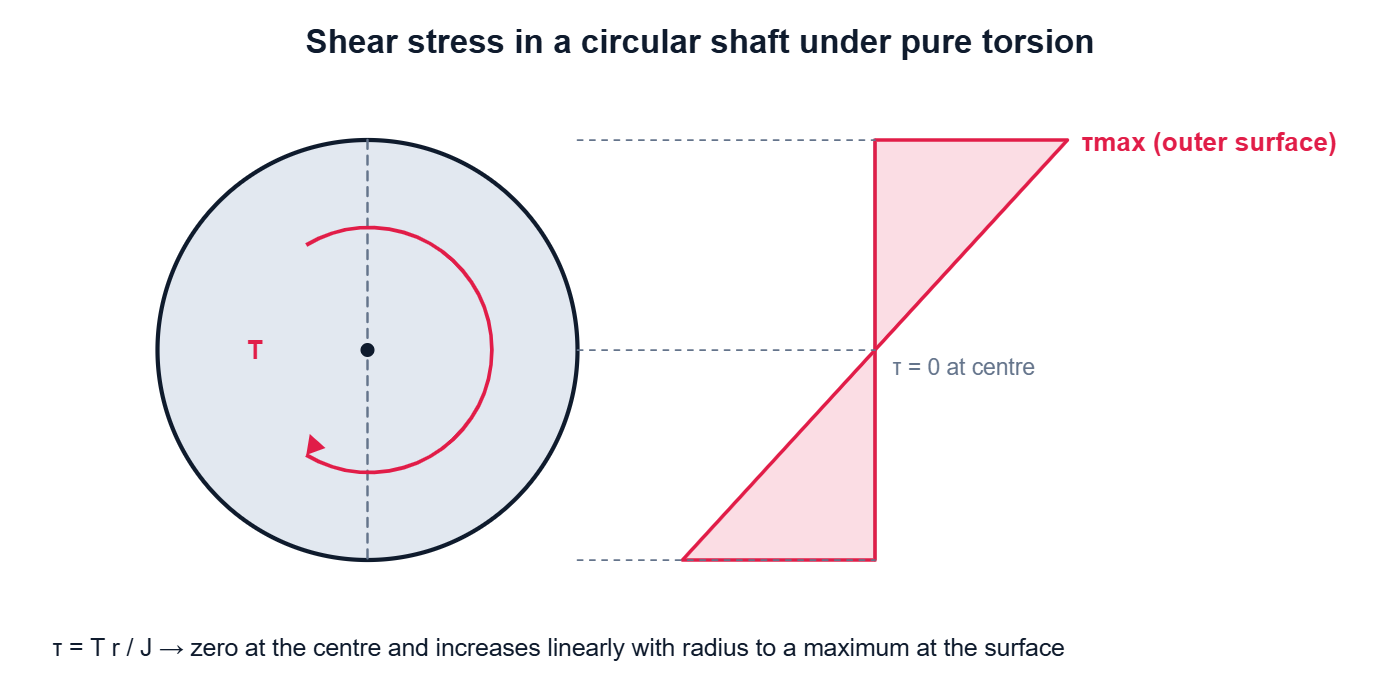
Correct answer: C) Zero at the center and increases linearly to a maximum at the outer surface.