For a rigid footing resting on clay, the contact pressure is
- Aconstant along base of the footing
- Bhigher at the edges and lower at the centreCorrect
- Clower at the edges and higher at the centre
- Dnone of the above
Solution
Concept
Contact Pressure Distribution on Clay
Formula
No specific formula (qualitative concept derived from Elastic Theory).
Step-by-step solution
1. Identify the footing type (rigid footing) and soil type (clay / cohesive soil). 2. Recall that a rigid footing undergoes uniform settlement across its base. 3. To maintain uniform settlement in clay, high stresses develop at the outer edges, resulting in contact pressure that is higher at the edges and lower at the center.
Explanation
For a rigid footing resting on cohesive soil like clay, settlement is uniform across the footing. To maintain uniform settlement, the soil provides higher reaction pressure near the outer edges and lower reaction pressure at the center.
Shortcut
Remember "Clay = High Edges, Sand = High Centre" (or CEH for Clay-Edges-High vs SCH for Sand-Centre-High). For a rigid footing, clay resists deformation at the outer boundaries, building up stress/pressure at the edges.
Common mistake
Students often confuse rigid footings with flexible footings and assume the contact pressure is uniform/constant along the base (Option A), or they mix up the behavior on clay with that on sand (Option C), where contact pressure is higher at the center and lower at the edges.
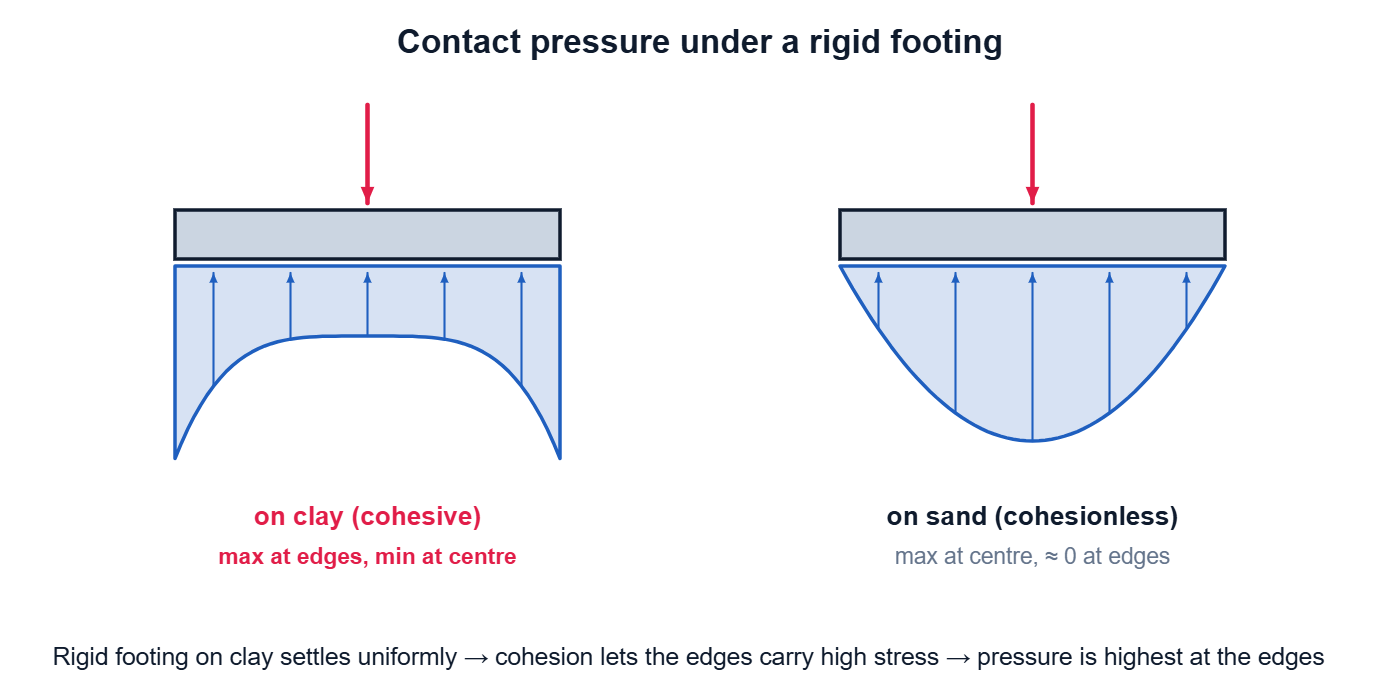
Correct answer: B) higher at the edges and lower at the centre