For the determination of an average annual precipitation in a catchment basin, the best method is
- AArithmetical method
- BThiessen's mean method
- CIsohyetal methodCorrect
- DNone of these
Solution
Concept
Isohyetal Method
Formula
Pavg = Σ(Ai × Pi) / A, where Pi is the average rainfall between two adjacent isohyets and Ai is the area between them.
Step-by-step solution
1. Calculate the average rainfall (P\_i) between each pair of adjacent isohyets: P\_i = (P1 + P2) / 2. 2. Multiply each average rainfall (P\_i) by the area (A\_i) between those two isohyets to find the volume equivalent: A\_i \* P\_i. 3. Sum the products of all segments: Σ(A\_i \* P\_i). 4. Divide the total sum by the total catchment area (A) to get P\_avg.
Explanation
The Isohyetal method is considered the best and most accurate method because it uses lines connecting points of equal rainfall (isohyets). This accounts for spatial variations, local topography, and unevenly distributed rain gauges across the catchment area.
Shortcut
Remember "Isohyetal = Ideal": Isohyetal is the most accurate/best method for average precipitation as it accounts for topography and spatial variation using lines of equal rainfall.
Common mistake
Many students choose Thiessen's mean method (Option B) because it accounts for area weighting, overlooking that the Isohyetal method is considered the most accurate as it also accounts for topography and spatial precipitation variations.
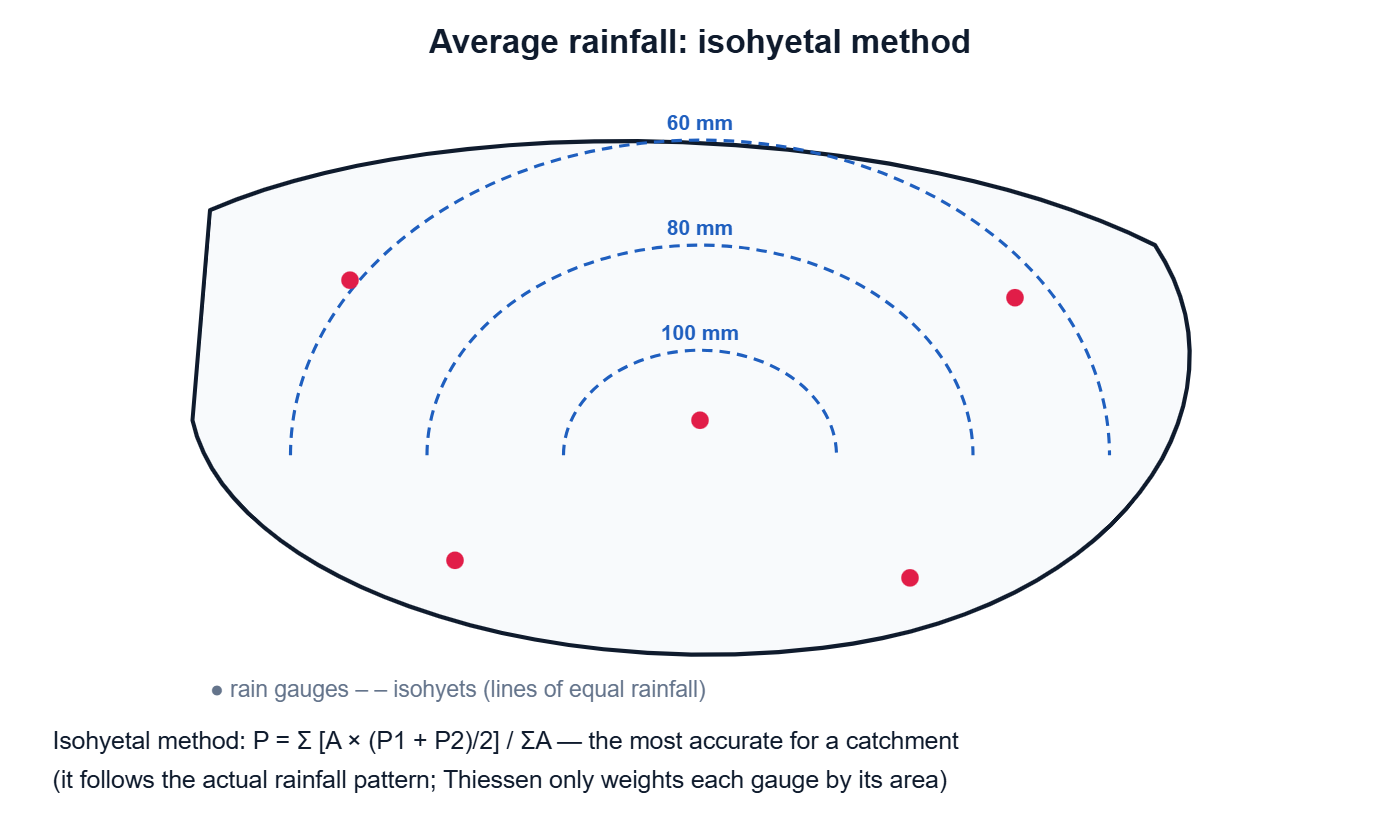
Correct answer: C) Isohyetal method