For the frame shown in the figure, the distribution factors for members DA, DB and DC are ________ respectively (Assume EI is same for all the members)
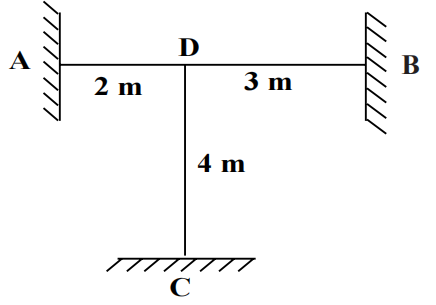
- A6/13, 4/13 and 3/13Correct
- B3/13, 4/13 and 6/13
- C4/13, 3/13 and 6/13
- Dnone of these
Solution
Concept
Distribution Factor
Formula
Yes. The key formulas used are:1. Member Stiffness: K = EI / L 2. Distribution Factor: DF = K / ΣK (where K is the stiffness of the individual member and ΣK is the total stiffness of all members meeting at the joint).
Step-by-step solution
1. Calculate stiffness (K = EI/L) for each member: K\_DA = EI/2, K\_DB = EI/3, K\_DC = EI/4. 2. Find total joint stiffness (ΣK): EI/2 + EI/3 + EI/4 = 13EI/12. 3. Divide each member stiffness by total stiffness to get DF: DF\_DA = 6/13, DF\_DB = 4/13, DF\_DC = 3/13.
Explanation
Stiffness (K) of a member is inversely proportional to its length (K = EI/L). For member DA (L = 2 m), stiffness K\_DA = EI/2 = 6EI/12. For member DB (L = 3 m), stiffness K\_DB = EI/3 = 4EI/12. For member DC (L = 4 m), stiffness K\_DC = EI/4 = 3EI/12. Total stiffness at joint D = (6 + 4 + 3)EI/12 = 13EI/12. The distribution factor for each member is its stiffness divided by the total stiffness: DF\_DA = (6/12) / (13/12) = 6/13 DF\_DB = (4/12) / (13/12) = 4/13 DF\_DC = (3/12) / (13/12) = 3/13
Shortcut
Since stiffness is inversely proportional to length (K ∝ 1/L), take the reciprocals of the member lengths (1/2, 1/3, 1/4), clear the fractions using the LCM of the lengths (12) to get the ratio 6 : 4 : 3, and then divide each number by their sum (13) to directly get 6/13, 4/13, and 3/13.
Common mistake
Students often assume the distribution factor is directly proportional to member length rather than inversely proportional to length (stiffness K = EI/L), leading them to incorrectly select Option B (3/13, 4/13, 6/13) instead of Option A (6/13, 4/13, 3/13).
Correct answer: A) 6/13, 4/13 and 3/13