If one support of a fixed-ended beam settles, then what is the nature of the end moments?
- AOne will be clockwise and another will be anticlockwise.
- BBoth will be either clockwise or anticlockwise.Correct
- CNo moments will be induced at the ends.
- DThe moments will be 3EI/L and in same sense.
Solution
Concept
If one end of a fixed beam settles by Δ, equal end moments of 6EIΔ/L² are induced, and both act in the same rotational sense.
Formula
MA = MB = 6EIΔ/L2
Step-by-step solution
1. Let support B sink by Δ relative to A, with no rotation at either end. 2. The beam bends into an S-shape (antisymmetric). 3. Fixed end moments: MAB = MBA = -6EIΔ/L2 (same sign convention). 4. Both moments have the same sense: both clockwise or both anticlockwise. 5. The moment depends on Δ, so it is 6EIΔ/L², not 3EI/L.
Explanation
When one support of a fixed beam settles, the beam deforms in an antisymmetric S-shape. Equal end moments of magnitude 6EIΔ/L² develop, and both act in the same direction (both clockwise or both anticlockwise). These two moments form a couple that is balanced by the vertical reactions.
Why the other options are wrong
A: Opposite senses occur for symmetric loading, not for support sinking. C: Settlement of a fixed beam always induces moments. D: The magnitude is 6EIΔ/L², not 3EI/L. 3EIΔ/L² is the propped cantilever case.
Shortcut
Support sinking in a fixed beam gives 6EIΔ/L² at both ends, in the same sense.
Common mistake
Using 3EIΔ/L², which is for a beam with one end fixed and the other pinned.
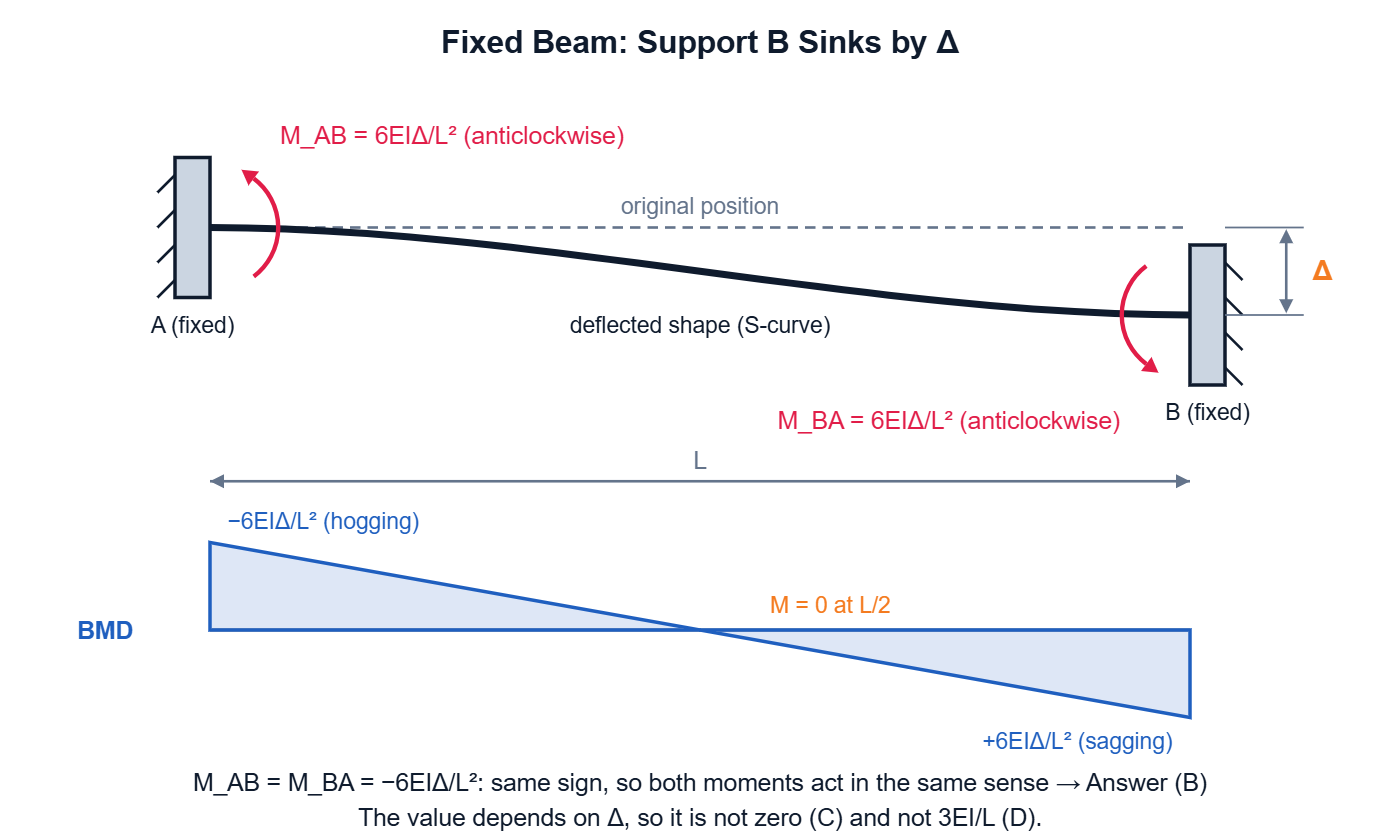
Correct answer: B) Both will be either clockwise or anticlockwise.