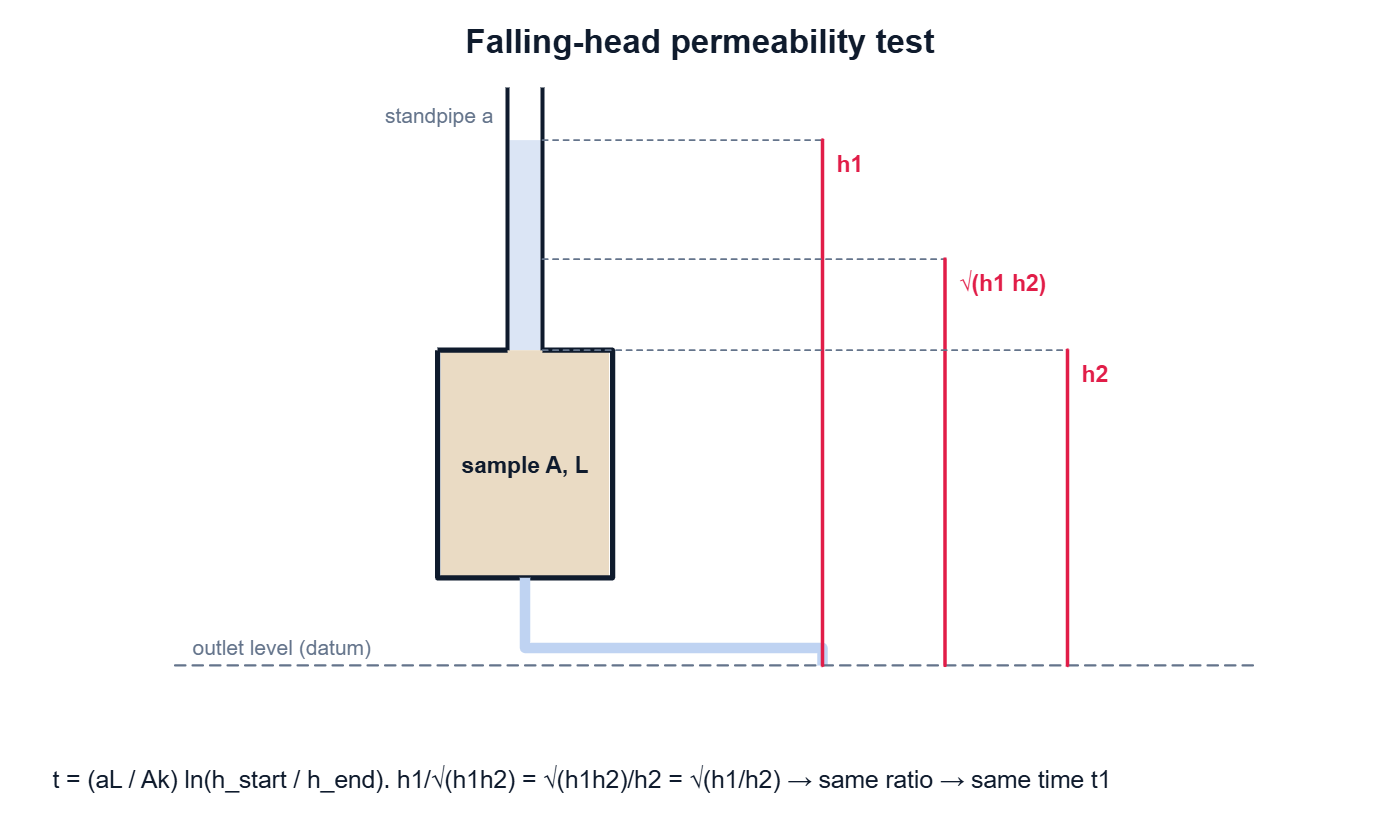
In a falling head permeability test, if t1 time is needed for head of water to drop from h1 to √(h1h2), then how much time is needed for head of water to drop from √(h1h2) to h2?
- A2t1
- B√t1
- Ct1²
- Dt1Correct
Solution
Concept
Falling Head Permeability Test
Formula
k = 2.303 × (a × L / (A × t)) × log10(h1 / h2)
Step-by-step solution
- Step 1: Time in a falling head test is proportional to ln(h\_initial / h\_final). - Step 2: For the first drop from h1 to √(h1·h2), head ratio = h1 / √(h1·h2) = √(h1/h2). - Step 3: For the second drop from √(h1·h2) to h2, head ratio = √(h1·h2) / h2 = √(h1/h2). - Step 4: Since the head ratios are identical, the required time is equal to t1.
Explanation
In a falling head permeability test, the time required for the water level to drop is proportional to the natural logarithm of the ratio of the initial head to the final head. Since the ratio of h1 to √(h1h2) is equal to the ratio of √(h1h2) to h2, both head drops have the exact same ratio, requiring equal time t1.
Shortcut
Equal head ratios mean equal time taken. Since the middle head is the geometric mean of the initial and final heads, the ratio of head drop for both intervals is identical, so the required time for the second drop is equal to t1.
Common mistake
Many students mistakenly assume a linear relationship between the head drop and time, or get confused by the square root in √(h1h2) and incorrectly select Option B (√t1) or Option A (2t1) instead of recognizing that equal head ratios result in equal time intervals.
Correct answer: D) t1