In a rigid joint plane frame structure, introduction of pins to all members at a joint produces additional equations equal to
- ANumber of members at the joint - 4
- BNumber of members at the joint - 2
- CNumber of members at the joint - 1Correct
- DNumber of members at the joint - 3
Solution
Concept
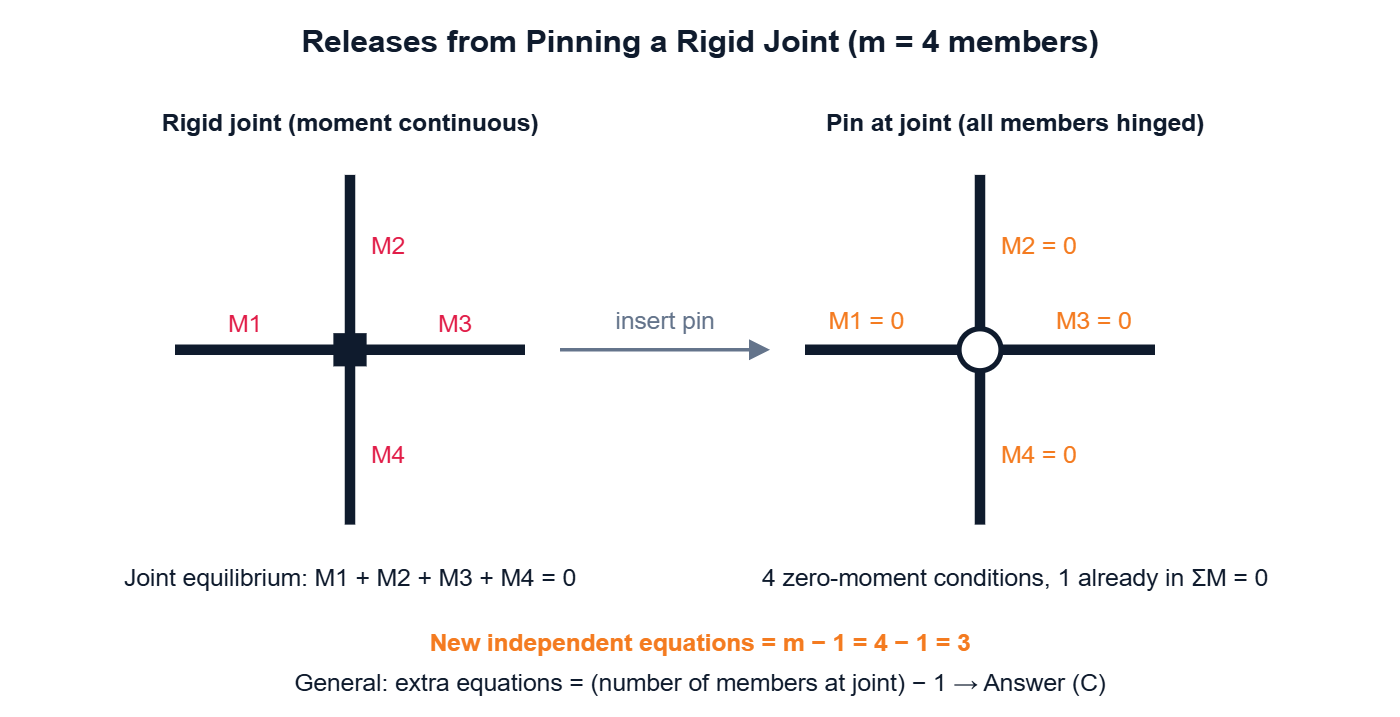
A pin (hinge) joining m members at a rigid joint gives (m - 1) extra equations of condition (moment releases).
Formula
r = m - 1, where m = number of members meeting at the hinged joint
Step-by-step solution
1. At a rigid joint, all m member ends rotate together, so moment is continuous. 2. A pin makes the moment zero in the member ends at that joint. 3. Joint moment equilibrium already links all m end moments with one equation. 4. So only (m - 1) of these zero-moment conditions are new and independent. 5. Extra equations = number of members at the joint - 1.
Explanation
A hinge joining m members gives m - 1 independent releases, because one moment condition is already covered by joint equilibrium. So the static indeterminacy goes down by m - 1.
Why the other options are wrong
A, B, D: they subtract 4, 2 or 3. The correct count is m - 1, because only one condition is already covered by joint equilibrium.
Shortcut
Releases at an internal hinge = (members meeting) - 1.
Common mistake
Taking releases = m (forgetting that joint equilibrium already gives one equation).
Correct answer: C) Number of members at the joint - 1