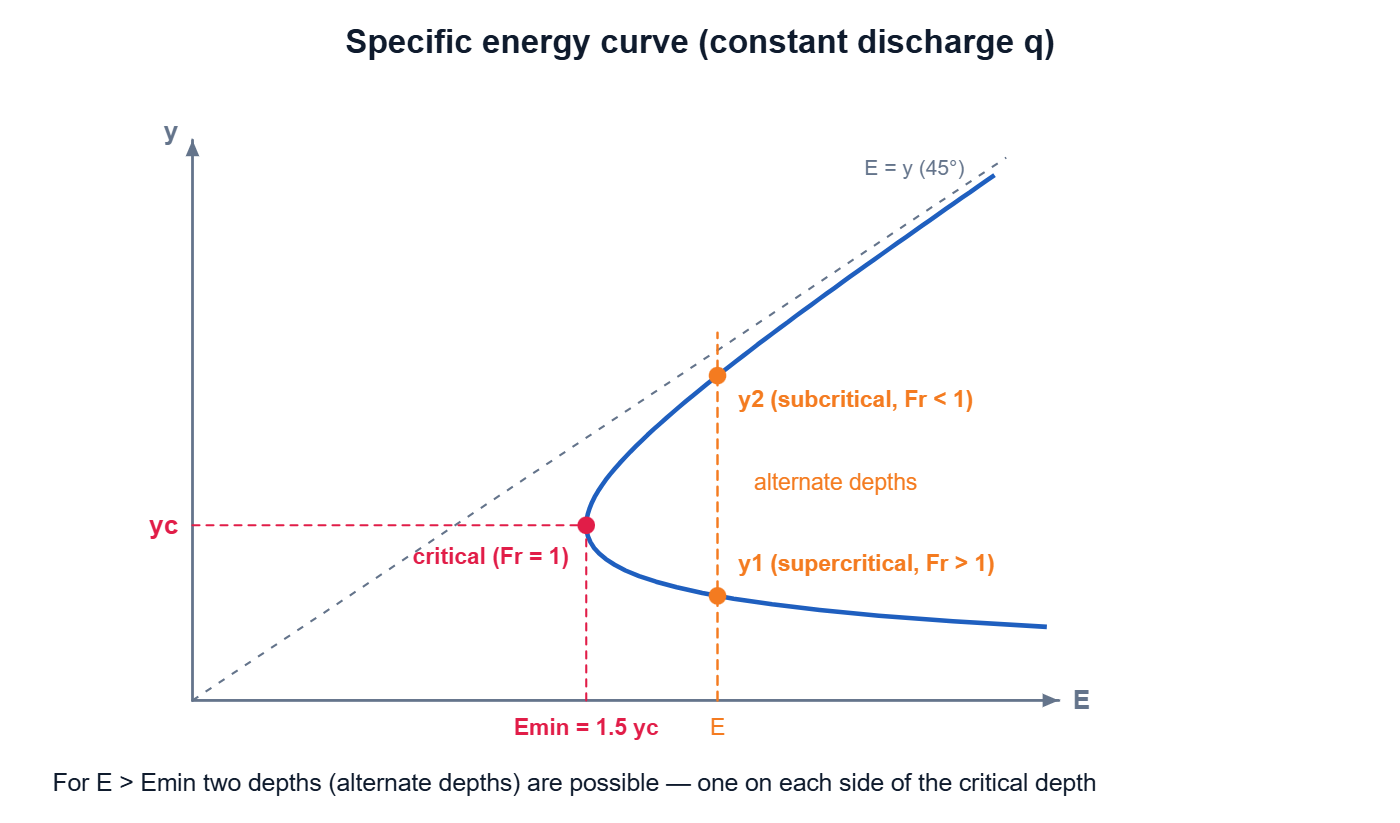
In a specific energy diagram, alternate depths are located
- AAt the peak of the curve
- BAt different energy levels
- COn either side of the critical depthCorrect
- DOnly for subcritical flows
Solution
Concept
Alternate Depths
Formula
E = y + q2 / (2 × g × y2)
Step-by-step solution
1. Set up the specific energy equation: E = y + q² / (2gy²). 2. For a fixed specific energy (E \> E\_min), solving for depth (y) yields two alternate depths: y₁ (subcritical, y₁ \> y\_c) and y₂ (supercritical, y₂ \< y\_c). 3. Since y₁ \> y\_c and y₂ \< y\_c, the alternate depths lie on either side of the critical depth (y\_c).
Explanation
In a specific energy diagram, for any given specific energy above the minimum level, two different depths can occur with the same energy. One depth is higher than the critical depth (subcritical flow) and the other is lower than the critical depth (supercritical flow), placing them on either side of the critical depth.
Shortcut
To easily remember this: Think of the critical depth ($y\_c$) as the middle/dividing line on the curve. For any specific energy above the minimum, one depth lies above it (subcritical) and one lies below it (supercritical)—meaning alternate depths are always on either side of the critical depth.
Common mistake
Many students incorrectly choose "At different energy levels" by confusing alternate depths (which occur at the same specific energy) with flow depths before and after a hydraulic jump (conjugate depths), which involve an energy loss.
Correct answer: C) On either side of the critical depth