Let P and Q be the reference points on the ground. You have to establish a point R. Which of the following methods conforms to the fundamental principles of surveying?
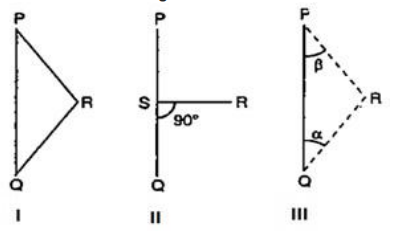
- AOnly I
- BOnly III
- CI, II and IIICorrect
- DOnly I and II
Solution
Concept
A new point can be fixed by two measurements (linear or angular) from two known reference points.
Step-by-step solution
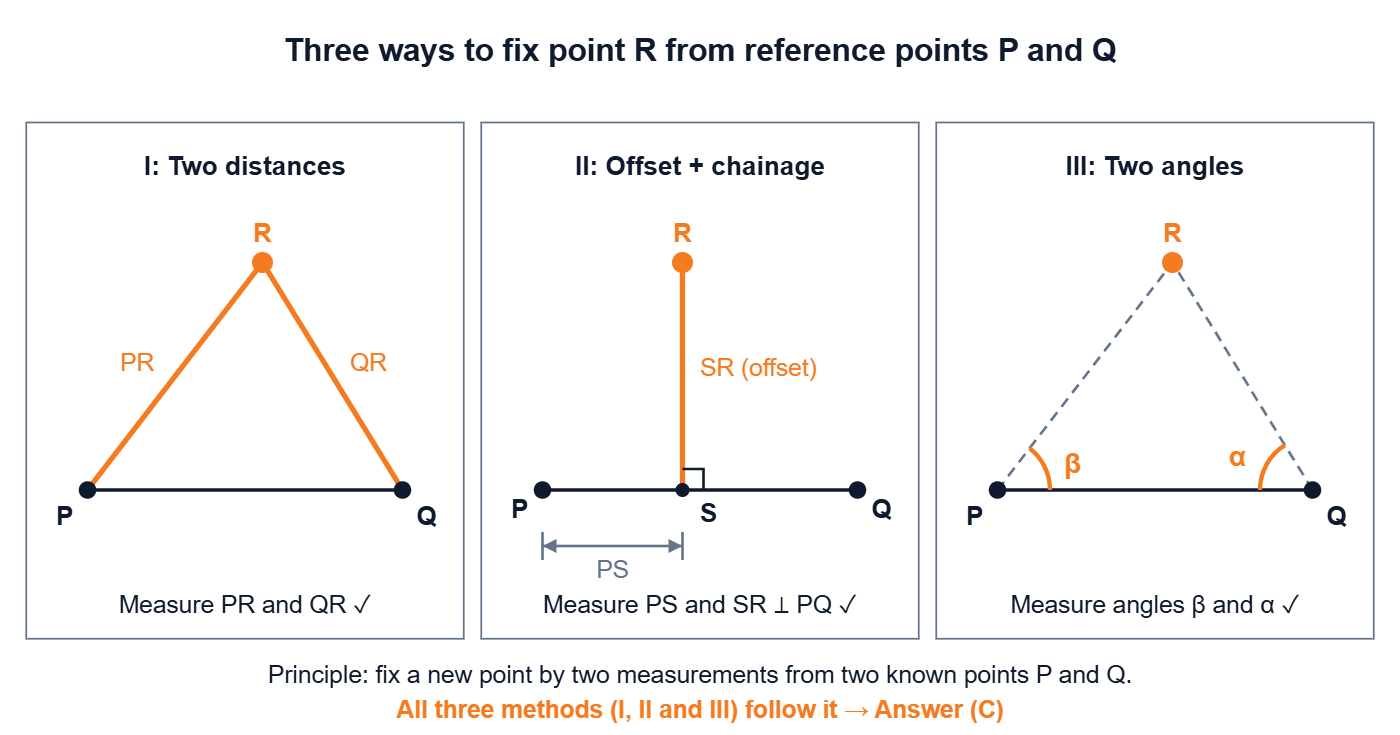
1. Principle: a point is located by measurements taken from two fixed reference points. 2. Figure I: distances PR and QR are measured. This is fixing by two distances (triangle method). It is correct. 3. Figure II: a perpendicular offset SR is taken from line PQ, with distance PS (or QS) measured. This is fixing by offset and chainage. It is correct. 4. Figure III: angles β at P and α at Q are measured. This is fixing by two angles (triangulation). It is correct. 5. All three methods follow the principle, so the answer is I, II and III.
Explanation
Surveying says we can locate a new point using any two measurements from two known points. Figure I uses two distances, Figure II uses a perpendicular offset with chainage, and Figure III uses two angles. All three are valid, so option C is correct.
Why the other options are wrong
A: misses II and III. B: misses I and II. D: misses III, but two angles from P and Q also fix R.
Shortcut
Two independent measurements (distance or angle) from two reference points fix any new point.
Common mistake
Thinking only linear measurements (I, II) are valid and forgetting angular measurement (triangulation).
Correct answer: C) I, II and III