Match the following markings drawn on the carriage way with their significances.
| List-I (Type of Line:) | List-II (Significance) |
|---|---|
| A.Double longitudinal solid lines | 1.Guiding and regulating line |
| B.Broken longitudinal lines | 2.Edge line |
| C.Solid longitudinal lines | 3.Indicate centre line or lane-marking for multi-lane roads |
| 4.Indicate maximum restriction and are only to be crossed in case of emergency |
- AA-1, B-3, C-4
- BA-4, B-3, C-1Correct
- CA-3, B-4, C-1
- DA-2, B-2, C-4
Solution
Concept
Longitudinal pavement markings: broken lines guide traffic, solid lines regulate, and double solid lines show maximum restriction.
Step-by-step solution
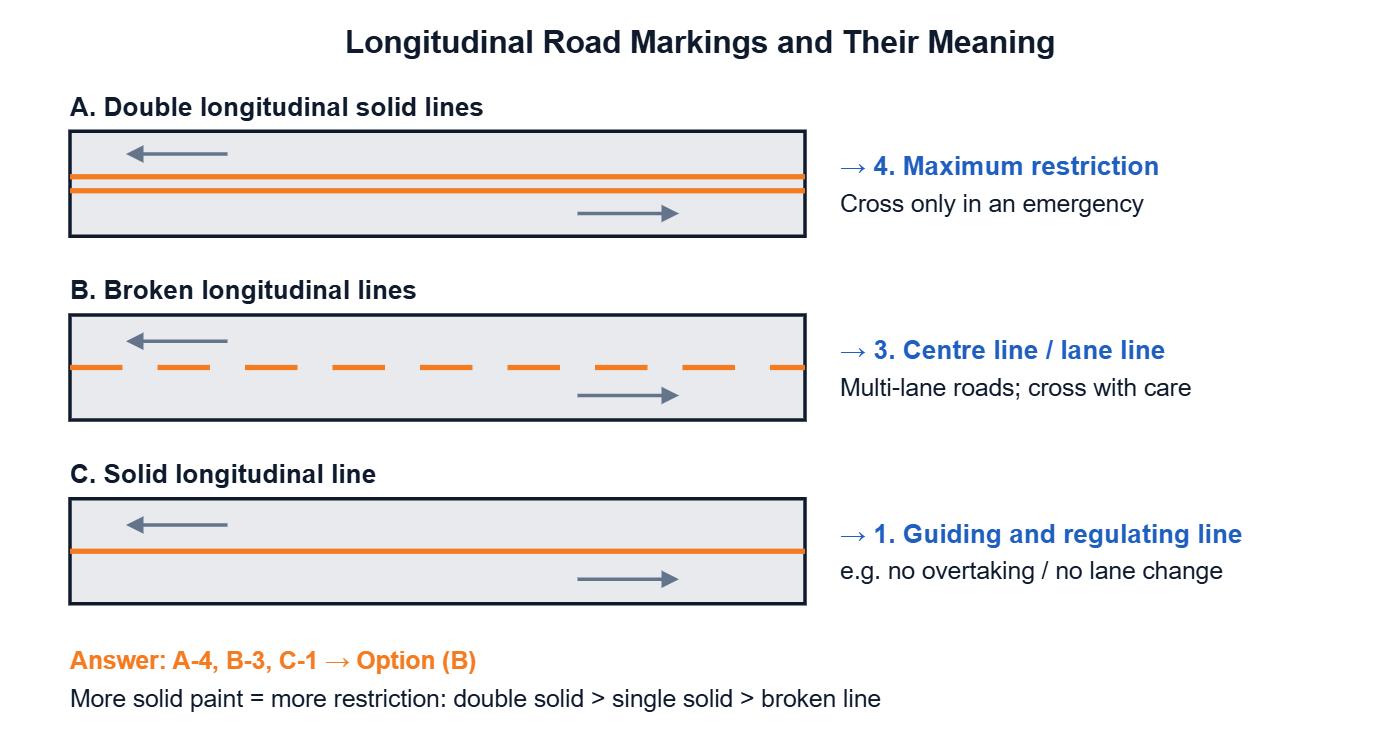
1. Double solid lines mean the strongest restriction. Do not cross except in an emergency. So A-4. 2. Broken lines are used as centre line or lane lines on multi-lane roads. Vehicles may cross them with care. So B-3. 3. Single solid lines guide and regulate traffic, for example no overtaking or no lane change. So C-1. 4. The correct match is A-4, B-3, C-1, which is option (B).
Explanation
On roads, a broken line means you may cross it carefully, a solid line means you should not cross it, and a double solid line means you must not cross it except in an emergency. Broken lines mark the centre line or lanes, and solid lines guide and regulate traffic. So the match is A-4, B-3, C-1.
Why the other options are wrong
(A) wrongly gives double solid lines a simple guiding role (A-1). (C) mixes up double solid lines and broken lines (A-3, B-4). (D) repeats the edge line for both A and B and gives maximum restriction to single solid lines.
Shortcut
More paint means more restriction: broken < solid < double solid.
Common mistake
Thinking a single solid line is the maximum restriction, or matching solid lines only with edge lines.
Correct answer: B) A-4, B-3, C-1