Statement (I): Cross drainage structure, aqueduct is constructed to negotiate an aligned channel over, below or at the same level of a stream. Statement (II): Aqueduct is constructed, when full supply level (FSL) of canal is much higher than high flood level (HFL) of a stream.
- ABoth Statement (I) and Statement (II) are individually true and Statement (II) is the correct explanation of Statement (I)
- BBoth Statement (I) and Statement (II) are individually true but Statement (II) is not the correct explanation of Statement (I)
- CStatement (I) is true but Statement (II) is false
- DStatement (I) is false but Statement (II) is trueCorrect
Solution
Concept
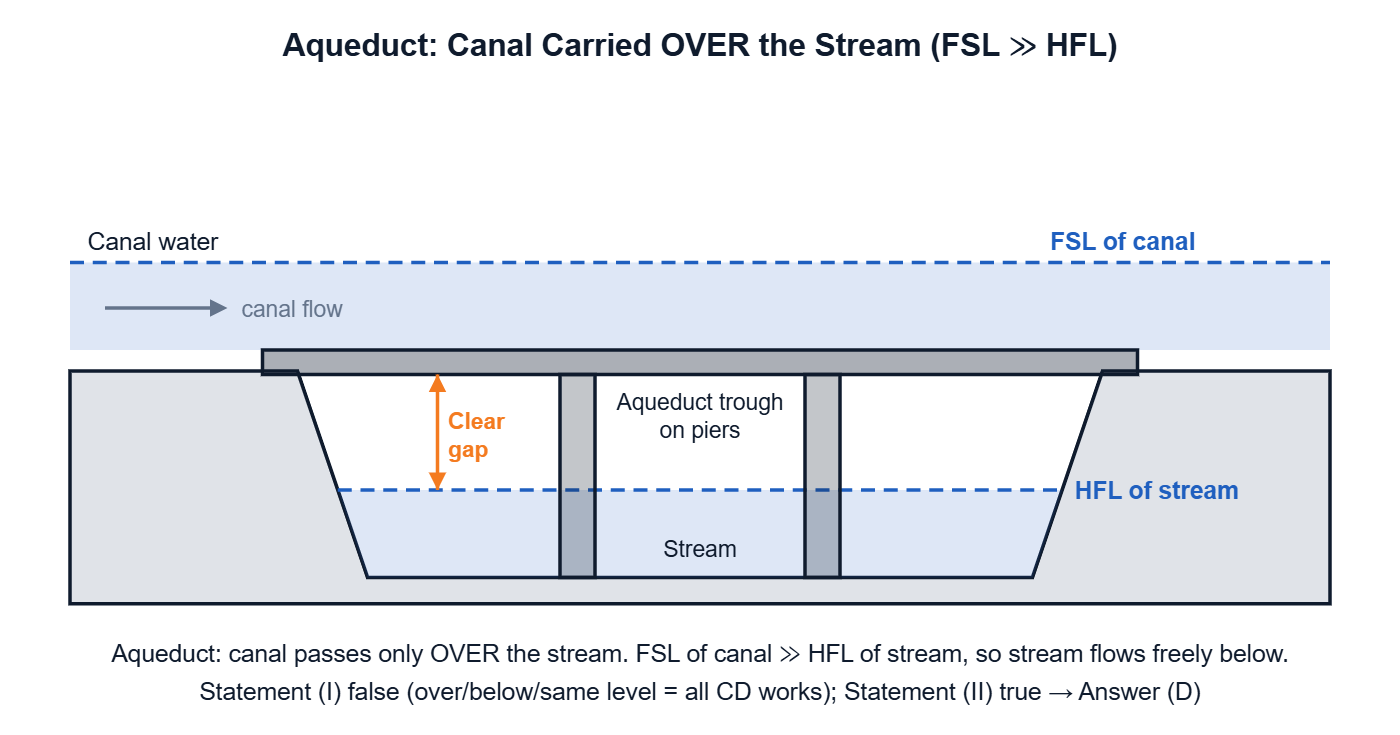
An aqueduct carries the canal over the stream. It is used when the canal bed and FSL are well above the HFL of the stream.
Step-by-step solution
1. Cross drainage works in general can carry the canal over, below, or at the same level as a stream. 2. An aqueduct is only the case where the canal passes over the stream. So Statement (I), which says an aqueduct does all three, is false. 3. An aqueduct is provided when the canal FSL (and bed) is much higher than the stream HFL, so the stream flows freely below. Statement (II) is true. 4. Answer: D.
Explanation
An aqueduct takes the canal over the drain like a bridge. Passing below the stream needs a super passage or syphon, and passing at the same level needs a level crossing. So (I) is wrong for an aqueduct, while (II) is correct.
Why the other options are wrong
A and B: (I) is false, so both cannot be true. C: (II) is actually true and (I) is false.
Shortcut
Aqueduct = canal over the stream, with canal FSL above stream HFL.
Common mistake
Confusing the general definition of cross drainage works with the specific aqueduct.
Correct answer: D) Statement (I) is false but Statement (II) is true