Statement (I): There may be as many unknown forces as there are equations of equilibrium; however, instability or movement of a structure or its members can develop because of improper constraining by the supports. Statement (II): This can occur if all the support reactions are concurrent at a point and when the reactive forces are all parallel.
- ABoth Statement (I) and Statement (II) are individually true and Statement (II) is the correct explanation of Statement (I)Correct
- BBoth Statement (I) and Statement (II) are individually true but Statement (II) is not the correct explanation of Statement (I)
- CStatement (I) is true but Statement (II) is false
- DStatement (I) is false but Statement (II) is true
Solution
Concept
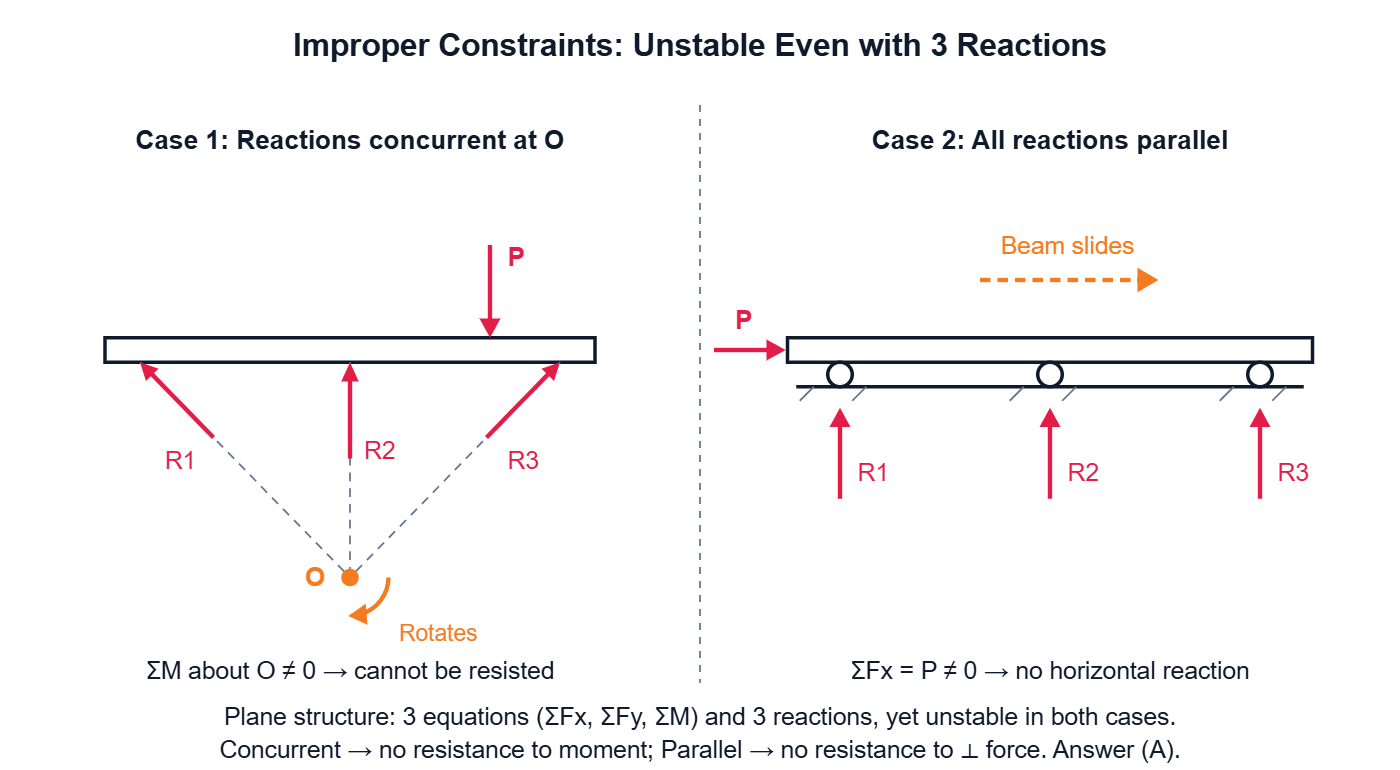
A structure with enough reactions can still be unstable if the supports are badly arranged, for example when all reactions are concurrent or all are parallel.
Formula
Stable only if r ≥ 3 (plane structure) AND reactions are neither all concurrent nor all parallel
Step-by-step solution
1. A plane structure has 3 equilibrium equations: ΣFx = 0, ΣFy = 0, ΣM = 0. 2. Having 3 reactions (unknowns = equations) is necessary but not enough for stability. 3. If all reaction lines meet at one point, they cannot resist a moment about that point. The structure can rotate, so it is unstable. 4. If all reactions are parallel, they cannot resist a force perpendicular to them. The structure can slide, so it is unstable. 5. So Statement (I) is true. Statement (II) gives these two cases of improper constraint, so it correctly explains (I).
Explanation
The number of reactions can equal the number of equilibrium equations and the structure can still move. This is called improper constraint, or geometric instability. It happens when the reactions are all concurrent (the body can rotate) or all parallel (the body can translate), so Statement (II) explains Statement (I).
Why the other options are wrong
B: Statement (II) gives the exact reason for the instability in Statement (I), so it is the correct explanation. C: Statement (II) is true. Concurrent or parallel reactions do cause instability. D: Statement (I) is true. Improper constraints cause instability even when unknowns = equations.
Shortcut
Remember: reactions concurrent = structure rotates; reactions parallel = structure slides. Both are improper constraints.
Common mistake
Thinking that 3 reactions always make a plane structure stable, without checking how the supports are arranged.
Correct answer: A) Both Statement (I) and Statement (II) are individually true and Statement (II) is the correct explanation of Statement (I)