The air vessel is not required for multi-cylinder pump because it has
- Amuch smaller fluctuations of velocity in both the delivery and suction pipesCorrect
- Blarge fluctuations of velocity in delivery pipes
- Clarge fluctuations of velocity in suction pipes
- Dmoderate variation of speed of fluid reciprocating pump
Solution
Concept
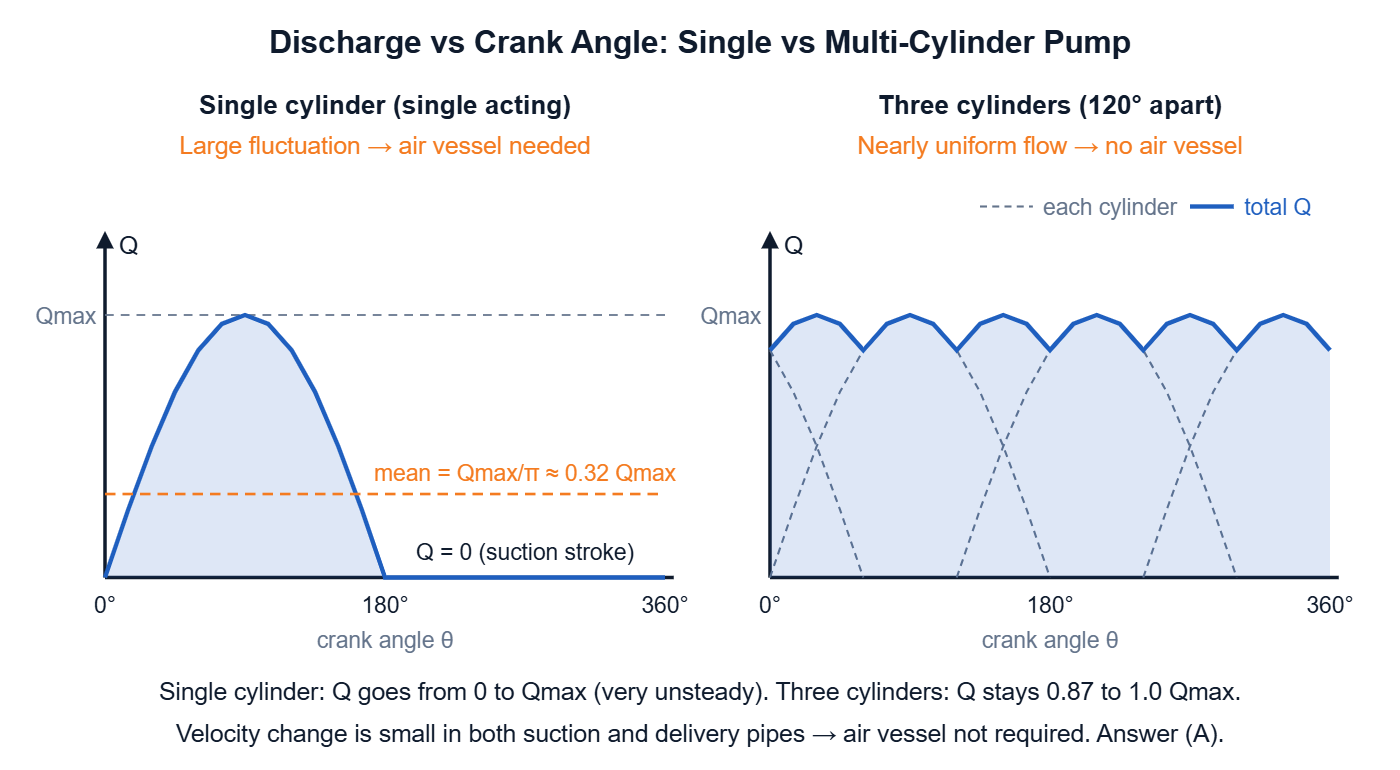
In a multi-cylinder pump the strokes overlap, so the total discharge is nearly uniform and an air vessel is not needed.
Step-by-step solution
1. An air vessel is fitted to a reciprocating pump to reduce velocity and pressure changes in the suction and delivery pipes. 2. In a single-cylinder pump the flow is very unsteady, so the fluctuations are large. 3. In a multi-cylinder pump (double or triple), the strokes are out of phase and the flows overlap. 4. So the total flow is almost uniform and velocity changes in both pipes are much smaller. 5. The air vessel is therefore not required. Answer is (A).
Explanation
A multi-cylinder pump has cranks set at different angles, so one cylinder delivers while another is still on suction. The combined discharge becomes nearly steady. Because velocity fluctuations in both suction and delivery pipes are already small, an air vessel is not needed.
Why the other options are wrong
B: Large fluctuations in the delivery pipe would need an air vessel, not remove the need. C: Large fluctuations in the suction pipe would also need an air vessel. D: Speed variation of the pump is not the reason. The reason is the smooth (uniform) discharge.
Shortcut
More cylinders give more uniform flow, so no air vessel is needed.
Common mistake
Thinking an air vessel is always needed for every reciprocating pump.
Correct answer: A) much smaller fluctuations of velocity in both the delivery and suction pipes