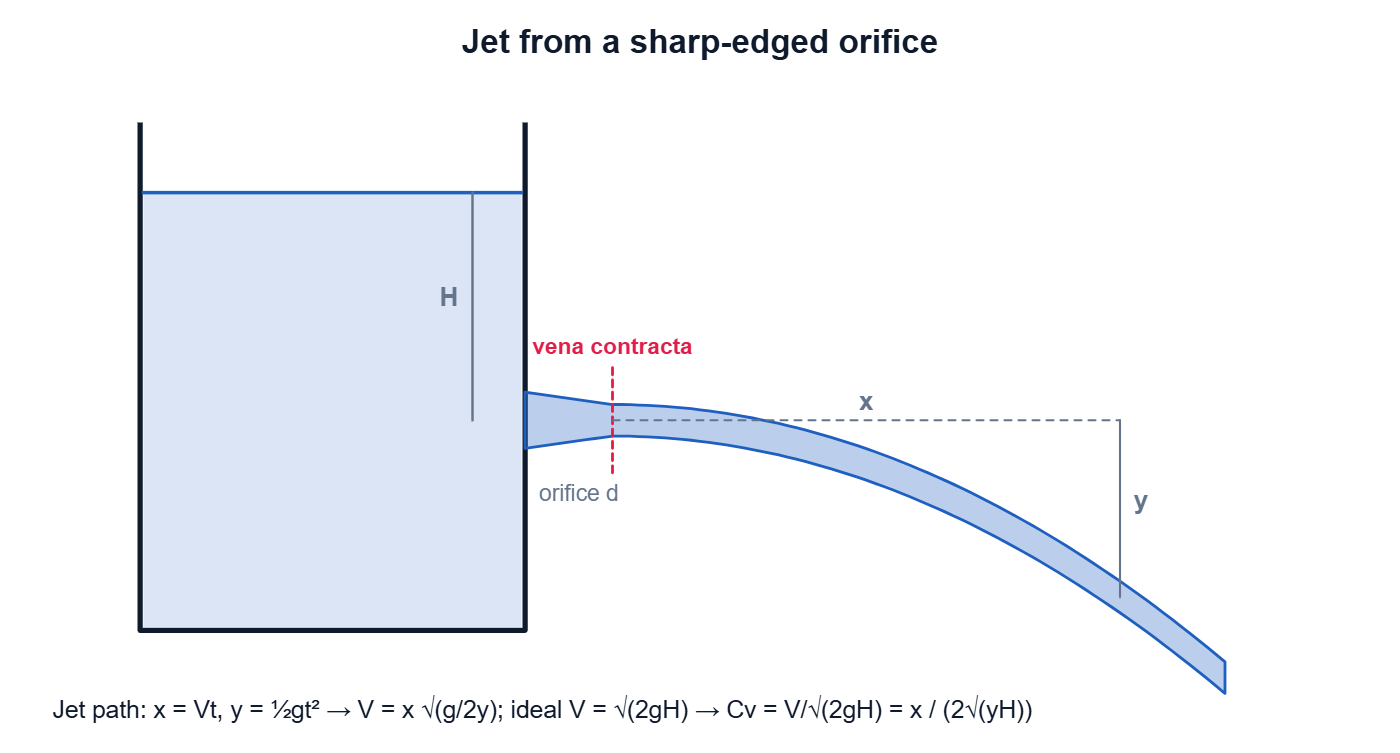
The coefficient of velocity (Cv) for an orifice is given by (where, H = head over the orifice; x = horizontal distance travelled by a particle in time (t) after it has left the vena-contracta and y = vertical distance travelled by a particle in the same time (t))
- ACv = x / (2√(yH))Correct
- BCv = 2x / √(yH)
- CCv = x / √(yH)
- DCv = x² / (2√(yH))
Solution
Concept
Experimental determination of Cv from the jet trajectory
Formula
Cv = x / (2√(y H))
Step-by-step solution
1. Actual velocity at vena contracta: x = V t, y = ½ g t². 2. So V = x √(g / 2y). 3. Theoretical velocity = √(2gH). 4. Cv = V / √(2gH) = x√(g/2y) / √(2gH) = x / (2√(yH)).
Explanation
Cv is the ratio of actual jet velocity to the theoretical velocity √(2gH). The actual velocity is found from the parabolic path of the jet, x = V t and y = ½ g t², which gives Cv = x / (2√(yH)).
Shortcut
Cv = x / (2√(yH)) = x / √(4yH).
Common mistake
Forgetting the factor of 2 because of mixing up with √(2gH).
Correct answer: A) Cv = x / (2√(yH))