The energy loss ΔE in a hydraulic jump depends on
- Aconjugate depthCorrect
- Binitial depth
- Csequent depth
- Dnone of these
Solution
Concept
Hydraulic Jump Energy Loss
Formula
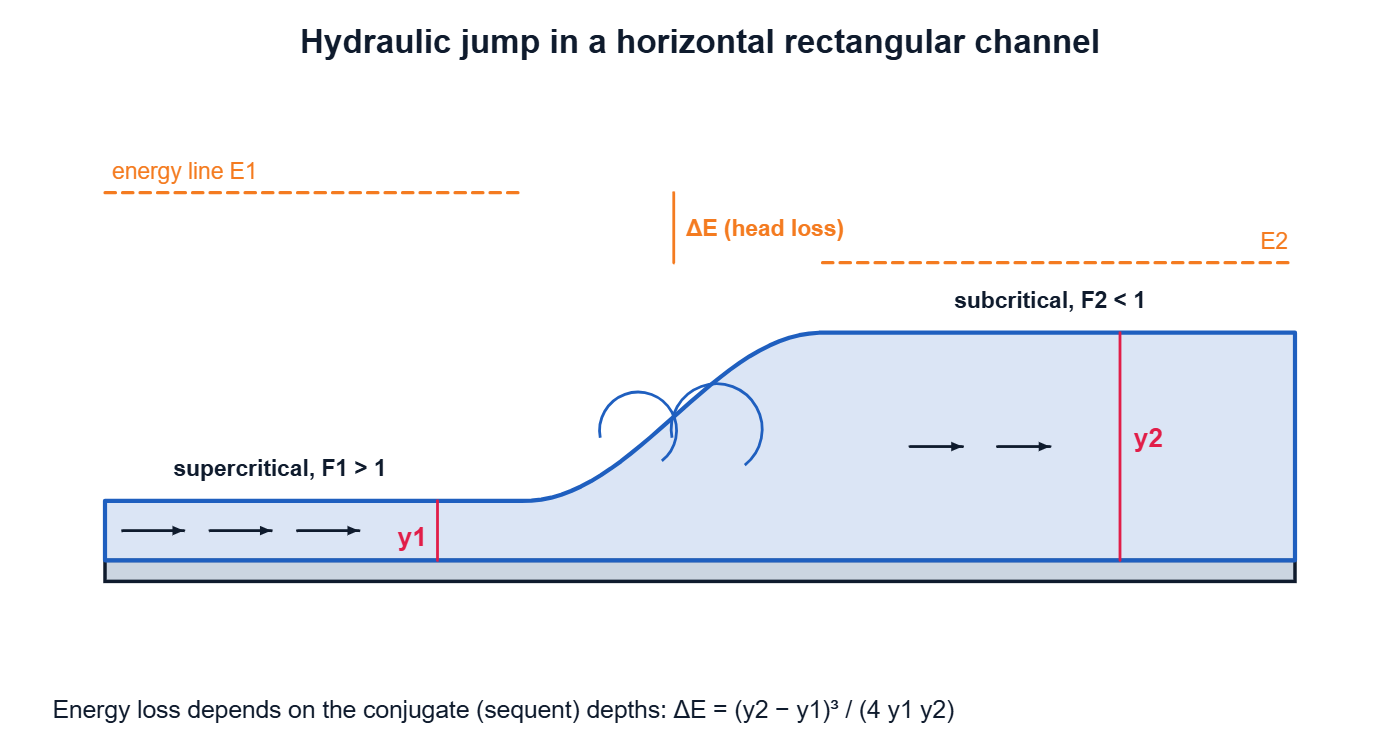
ΔE = (y₂ - y₁)³ / (4y₁y₂)
Step-by-step solution
1. Identify the initial depth y1 and the sequent depth y2. 2. Calculate the difference between the depths (y2 - y1) and cube the result. 3. Multiply 4 by y1 and y2 to get the denominator. 4. Divide the cubed difference by the denominator to find the energy loss ΔE.
Explanation
In a hydraulic jump, the energy loss depends directly on the water depths before and after the jump, which are known as conjugate depths. The bigger the difference between these two water levels, the more energy is lost as turbulence and heat.
Shortcut
Remember: Energy loss in a hydraulic jump needs both depths before and after the jump (y1 & y2) together—these paired depths are called conjugate depths. Formula: ΔE = (y₂ - y₁)³ / (4y₁y₂).
Common mistake
Many students mistakenly choose "initial depth" or "sequent depth" individually, forgetting that the energy loss depends on both water depths before and after the jump together (the pair of depths), which are collectively referred to as "conjugate depths."
Correct answer: A) conjugate depth