The pressure distribution in a liquid subjected to a constant horizontal acceleration is
- Asame as hydrostatic pressure distributionCorrect
- Bless than the hydrostatic pressure distribution
- Cmore than the hydrostatic pressure distribution
- Dequal to hydrostatic pressure distribution minus weight of liquid
Solution
Concept
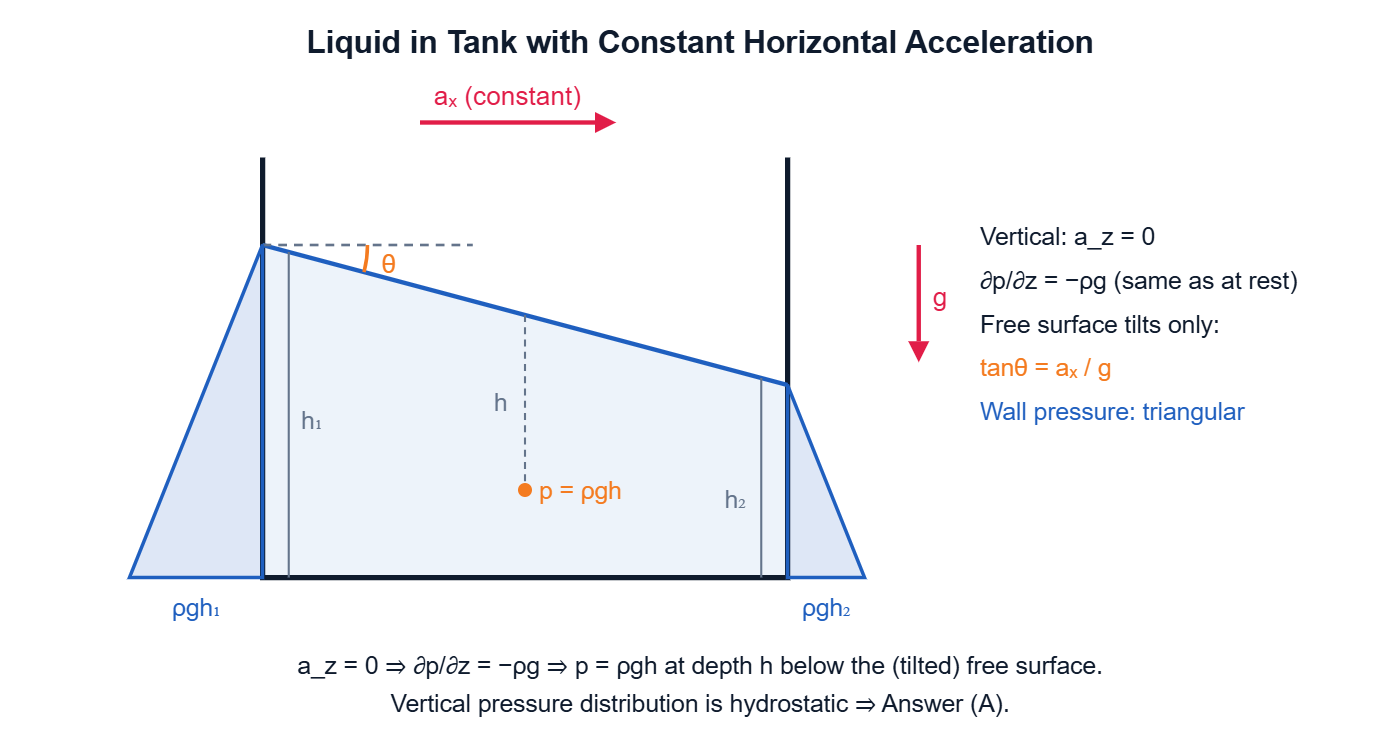
Under constant horizontal acceleration, pressure changes in the vertical direction in the same way as hydrostatic pressure.
Formula
∂p/∂z = -ρg ; ∂p/∂x = -ρax ; tanθ = ax/g
Step-by-step solution
1. For horizontal acceleration ax, there is no vertical acceleration (az = 0). 2. So in the vertical direction, ∂p/∂z = -ρg, which is the same as in a liquid at rest. 3. Pressure at depth h below the free surface is p = ρgh. 4. Only the free surface tilts, at angle θ where tanθ = ax/g. 5. So the vertical pressure distribution is the same as hydrostatic.
Explanation
With horizontal acceleration, the free surface becomes an inclined plane. Along any vertical line, pressure still increases as ρgh from the free surface. So the vertical pressure distribution is hydrostatic.
Why the other options are wrong
B and C: vertical acceleration is zero, so pressure is not reduced or increased in the vertical direction. D: subtracting the weight of the liquid has no physical meaning here.
Shortcut
Horizontal acceleration changes only the slope of the free surface, not the vertical pressure law.
Common mistake
Confusing this with vertical acceleration, where p = ρh(g ± a) and the distribution changes.
Correct answer: A) same as hydrostatic pressure distribution