The right limb of height h₂ in the simple U-tube manometer containing mercury is open to atmosphere, while the left limb of height h₁ is connected to pipe in which a liquid of specific gravity 1 is flowing with uniform speed with h₁ < h₂. This condition gives _____ kind of pressure.
- Anegative gauge pressure
- Bpositive gauge pressureCorrect
- Catmospheric pressure
- Dabsolute pressure
Solution
Concept
In a U-tube manometer, if the mercury level in the open limb is higher than in the pipe limb, the pipe pressure is above atmospheric.
Formula
pA = Sm × w × h₂ − S × w × h₁
Step-by-step solution
1. Take the datum at the mercury surface in the left limb. 2. Pressure in left limb at datum = pA + S × w × h₁, with S = 1 for the pipe liquid. 3. Pressure in right limb at datum = Sm × w × h₂, with Sm = 13.6 and the top open to atmosphere. 4. Equate both: pA = 13.6 × w × h₂ − 1 × w × h₁. 5. Since h₂ > h₁ and 13.6 > 1, pA > 0. 6. So the pipe has positive gauge pressure.
Explanation
The pipe liquid pushes the mercury down in the left limb and up in the right limb. Since the mercury column h₂ is taller and mercury is much heavier, the pipe pressure is more than atmospheric. So the gauge pressure is positive.
Why the other options are wrong
A: Negative gauge pressure would make the mercury rise in the left limb, not the right. C: At atmospheric pressure the mercury levels would be equal, with zero difference. D: A manometer reads gauge pressure, not absolute pressure.
Shortcut
Mercury pushed up in the open limb means pipe pressure is above atmospheric, so gauge pressure is positive.
Common mistake
Thinking that h₁ < h₂ means pipe pressure is low. Actually, a higher mercury column in the open limb means higher pipe pressure.
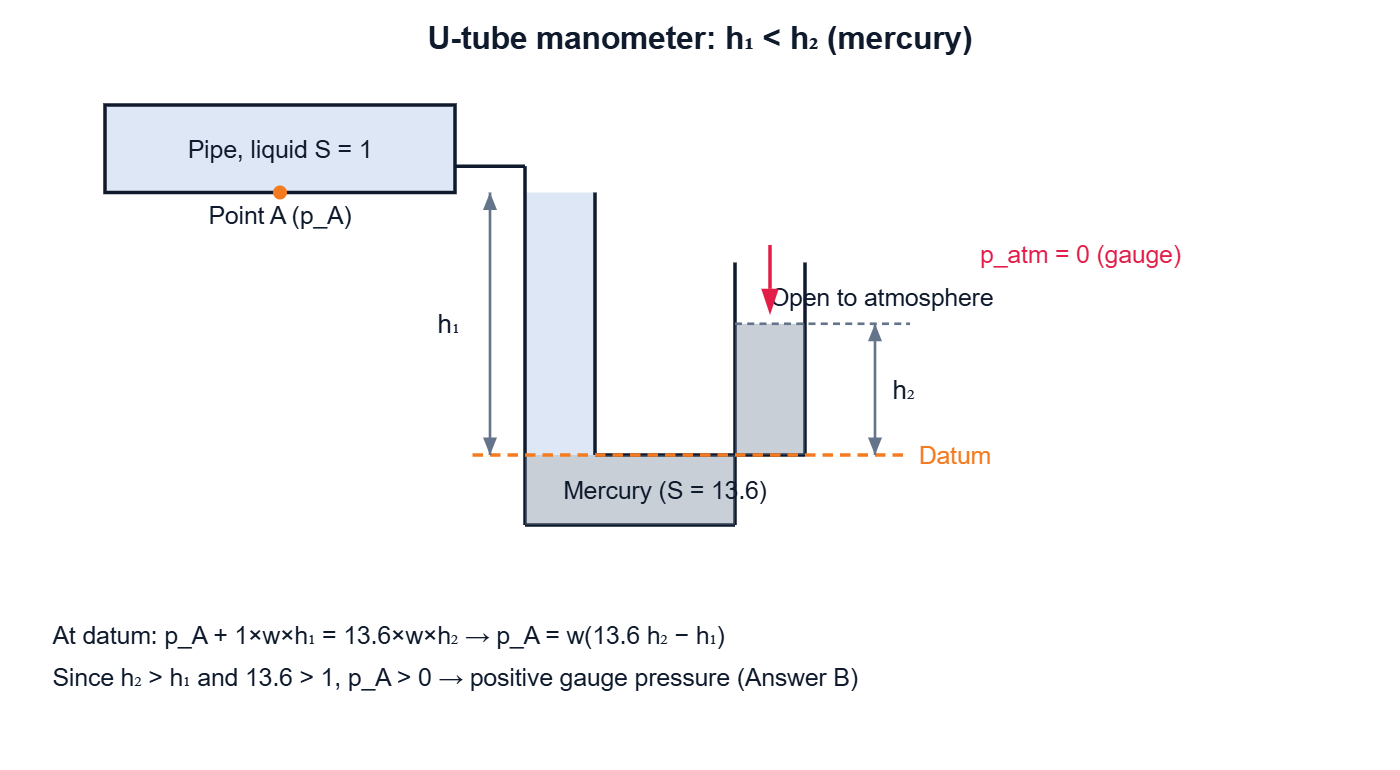
Correct answer: B) positive gauge pressure