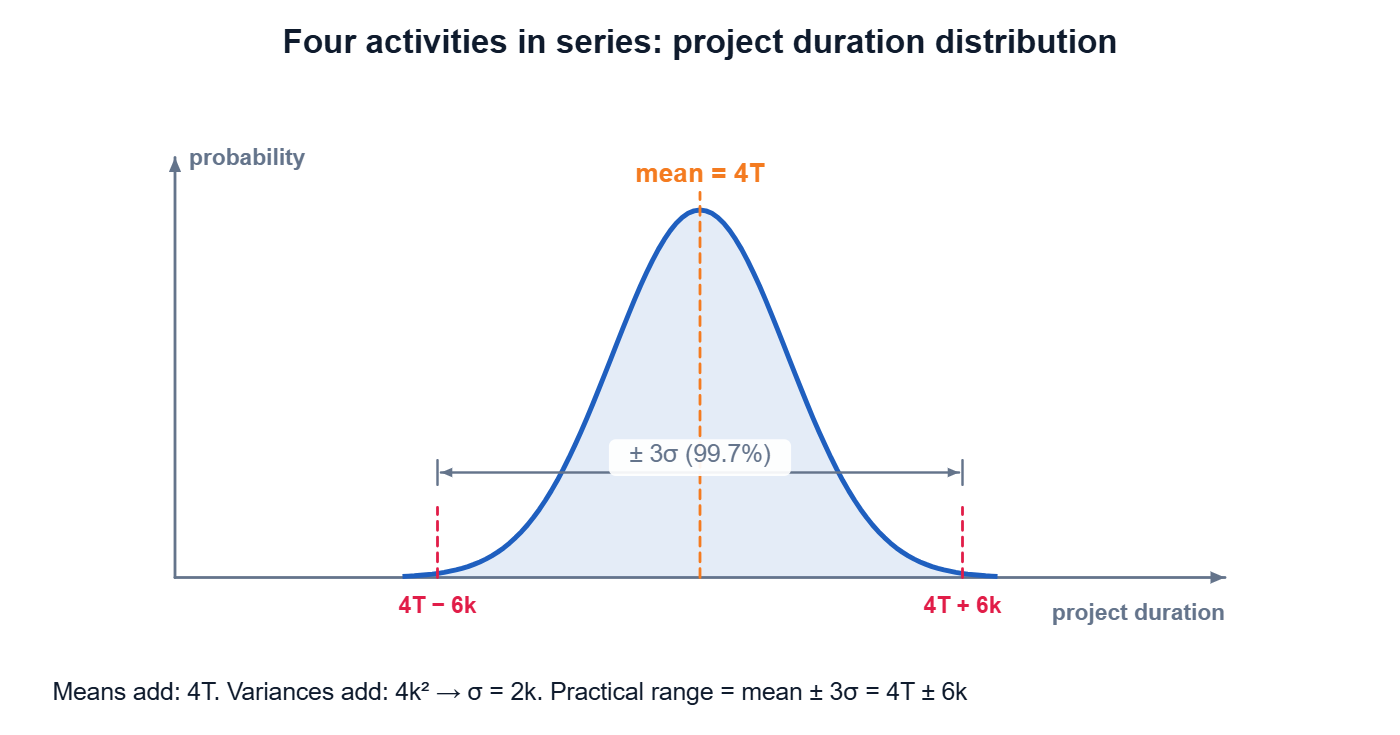
There are four consecutive activities in a simple linear network, each with mean duration of T and each with 'k' as the standard deviation of its duration. The overall project duration through these activities is likely to be in the range
- A4T ± k
- B4T ± 2k
- C4T ± 4k
- D4T ± 6kCorrect
Solution
Concept
Project Duration Range and Standard Deviation
Formula
Ttotal = Σ Ti, σtotal = √(Σ σi²), Range = Ttotal ± 3σtotal
Step-by-step solution
1. Calculate mean duration: T\_total = T + T + T + T = 4T 2. Calculate total variance: σ\_total² = k² + k² + k² + k² = 4k² 3. Calculate standard deviation: σ\_total = √(4k²) = 2k 4. Apply 3σ range: Range = 4T ± 3(2k) = 4T ± 6k
Explanation
For four consecutive activities, the total mean project duration is the sum of their individual mean durations: T + T + T + T = 4T. To find the overall standard deviation, we first calculate the total variance by adding the variances of each activity: k² + k² + k² + k² = 4k². The overall standard deviation is the square root of the total variance, which is √(4k²) = 2k. In statistics, project duration generally falls within three standard deviations (3σ rule) from the mean (99.73% confidence level). Multiplying 3 by the overall standard deviation of 2k gives 6k. Therefore, the overall project duration is likely to fall in the range of 4T ± 6k.
Shortcut
Total SD = √(number of activities) × k = √4 × k = 2k. Apply the 3-σ rule: range = Mean ± 3 × (Total SD) = 4T ± 3(2k) = 4T ± 6k.
Common mistake
A common mistake is directly adding the standard deviations (k + k + k + k = 4k) instead of summing the variances (k² + k² + k² + k² = 4k², giving an overall standard deviation of 2k), leading students to incorrectly choose Option C (4T ± 4k) or Option B (4T ± 2k) by forgetting to apply the 3-σ rule (3 × 2k = 6k).
Correct answer: D) 4T ± 6k