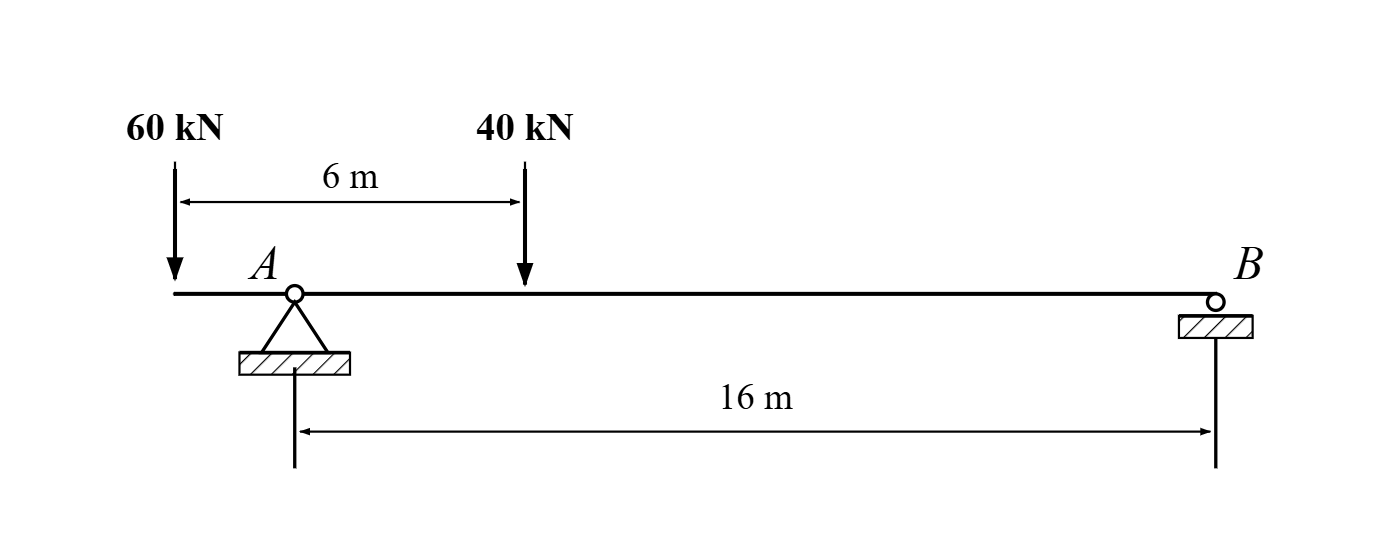
Two loads of 40 kN and 60 kN (spaced 6 m apart, with 40 kN leading) are moving towards support B on a simply supported span AB of 16 m as shown in figure. What is the maximum negative shear force at B?
- A-77.5 kNCorrect
- B-7.75 kN
- C-37.5 kN
- D-3.75 kN
Solution
Concept
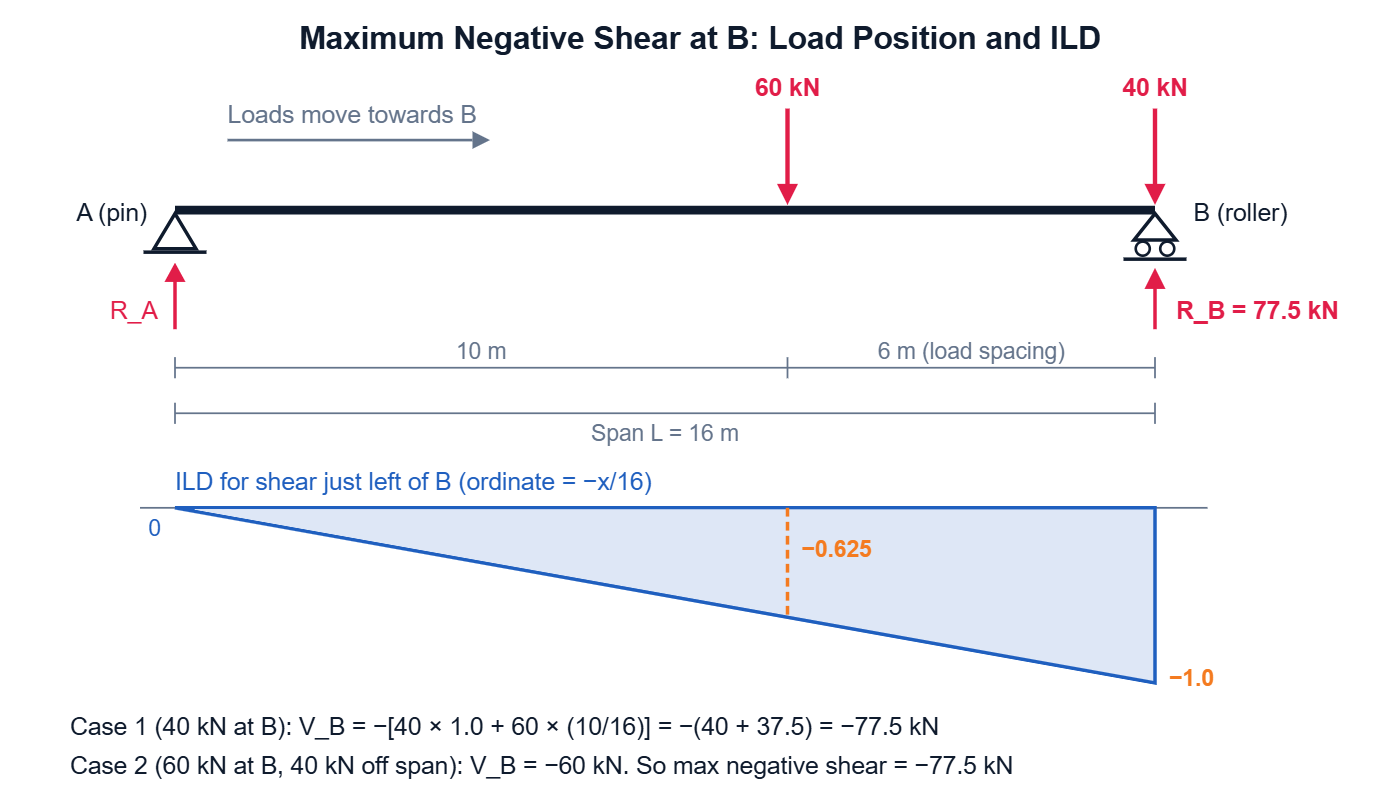
Shear just left of support B = -RB. The ILD for RB is a triangle with ordinate 1 at B and 0 at A. Place the loads to get the largest RB.
Formula
VB = -RB = -Σ Pi × (xi / L)
Step-by-step solution
1. Span L = 16 m. ILD of RB: ordinate = x/16, where x is measured from A. 2. Case 1: 40 kN at B (x = 16), 60 kN at x = 10 m. RB = 40 × 1 + 60 × (10/16) = 40 + 37.5 = 77.5 kN. 3. Case 2: 60 kN at B. Then the 40 kN load is already past B (off the span). RB = 60 × 1 = 60 kN. 4. Maximum RB = 77.5 kN (Case 1). 5. Maximum negative shear at B = -77.5 kN.
Explanation
Shear just left of B equals minus the reaction at B. We get the largest reaction at B when the 40 kN load is at B and the 60 kN load is 6 m behind it. This gives RB = 77.5 kN, so the shear is -77.5 kN.
Why the other options are wrong
B (-7.75) and D (-3.75): wrong decimal place. C (-37.5): this is only the share of the 60 kN load. The 40 kN load at B is missed.
Shortcut
Put the leading load at B: V = -(40 + 60 × 10/16) = -77.5 kN.
Common mistake
Correct answer: A) -77.5 kN