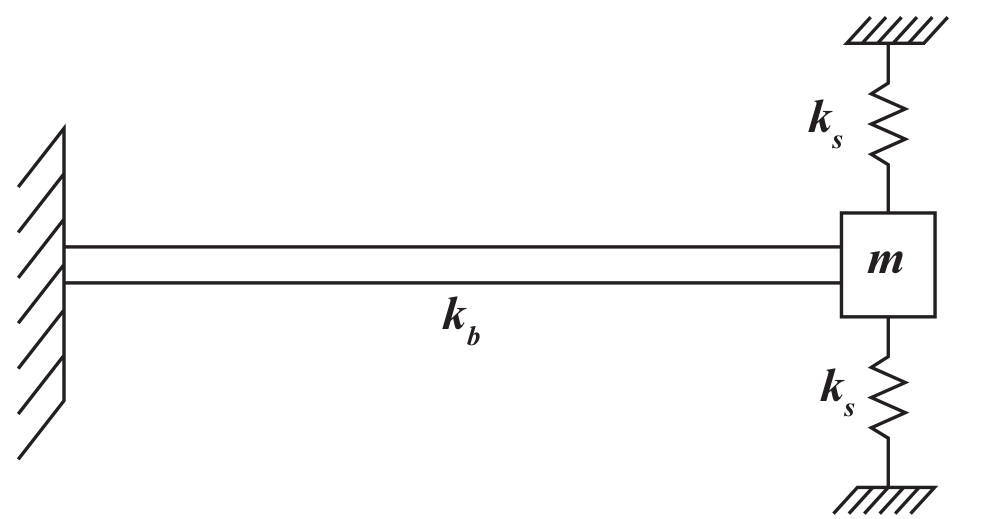
What is the equivalent stiffness (keq) of the system shown in the following figure, if kb is the stiffness of the massless beam and ks is the stiffness of each spring?
- Akeq = kb + 2ks
- Bkeq = (kb × 2ks)/(kb + 2ks)Correct
- Ckeq = kb × 2ks
- Dkeq = 1/(1/kb + 1/2ks)
Solution
Concept
Equivalent stiffness of spring and beam systems
Formula
1 / keq = 1 / kb + 1 / (2 × ks)
Step-by-step solution
1. The system consists of the beam stiffness kb connected in series with two parallel springs each of stiffness ks (total spring stiffness 2ks). 2. For series spring combinations, 1/keq = 1/kb + 1/(2ks). 3. Expressing this in reciprocal form gives keq = 1/(1/kb + 1/2ks). Answer: B
Explanation
The two springs act together in parallel, providing a combined spring stiffness of two times ks. This spring combination is connected in series with the beam of stiffness kb, requiring a harmonic mean formula to find the overall stiffness. Therefore, option B correctly gives the equivalent stiffness expression for these series-connected components.
Why the other options are wrong
A) Direct addition of stiffnesses applies to parallel systems, whereas this represents a series connection. C) Multiplying stiffness values directly does not give the equivalent stiffness of elements in series.
Shortcut
Beam and springs in series: equivalent stiffness keq = (kb × 2ks) / (kb + 2ks).
Common mistake
Assuming the beam and springs are connected in parallel rather than in series and selecting option A.
Correct answer: B) keq = (kb × 2ks)/(kb + 2ks)