What is the ratio of elongation of a rectangular bar due to self-weight to the elongation if total weight of the bar is applied at its end?
- A1/2Correct
- B2
- C1/3
- D3
Solution
Concept
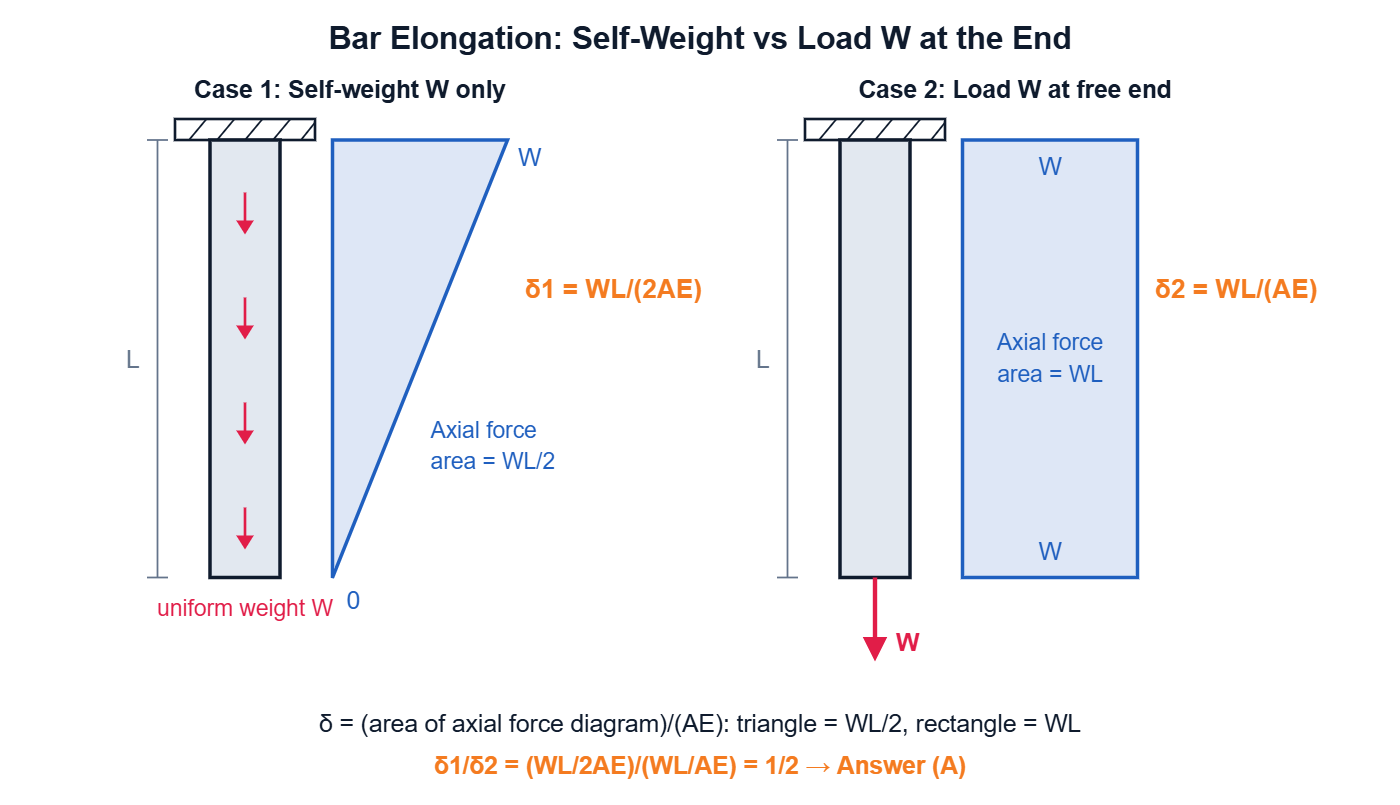
A bar under its own weight stretches half as much as when its full weight hangs at the free end.
Formula
δself = WL/(2AE), δend = WL/(AE)
Step-by-step solution
1. Let total weight of bar = W, length = L, area = A, modulus = E. 2. Elongation due to self-weight: δ1 = WL/(2AE). 3. Elongation when W acts at the end: δ2 = WL/(AE). 4. Ratio δ1/δ2 = (WL/2AE)/(WL/AE) = 1/2.
Explanation
Under self-weight, the force in the bar grows from zero at the free end to W at the support, so the average force is W/2. With W at the end, the full force W acts over the whole length. So self-weight elongation is half.
Why the other options are wrong
B (2) is the inverse ratio. C (1/3) and D (3) have no basis for a prismatic bar; the factor 1/3 relates to the volume of a cone, not to this case.
Shortcut
Self-weight acts like W/2 at the end, so the ratio is 1/2.
Common mistake
Writing the ratio upside down (2 instead of 1/2).
Correct answer: A) 1/2