Which of the following statements is correct about measurement of the vertical angle while using a total station?
- AAn electronic digital theodolite is not able to measure the vertical angle.
- BIt is measured relative to the horizontal direction.
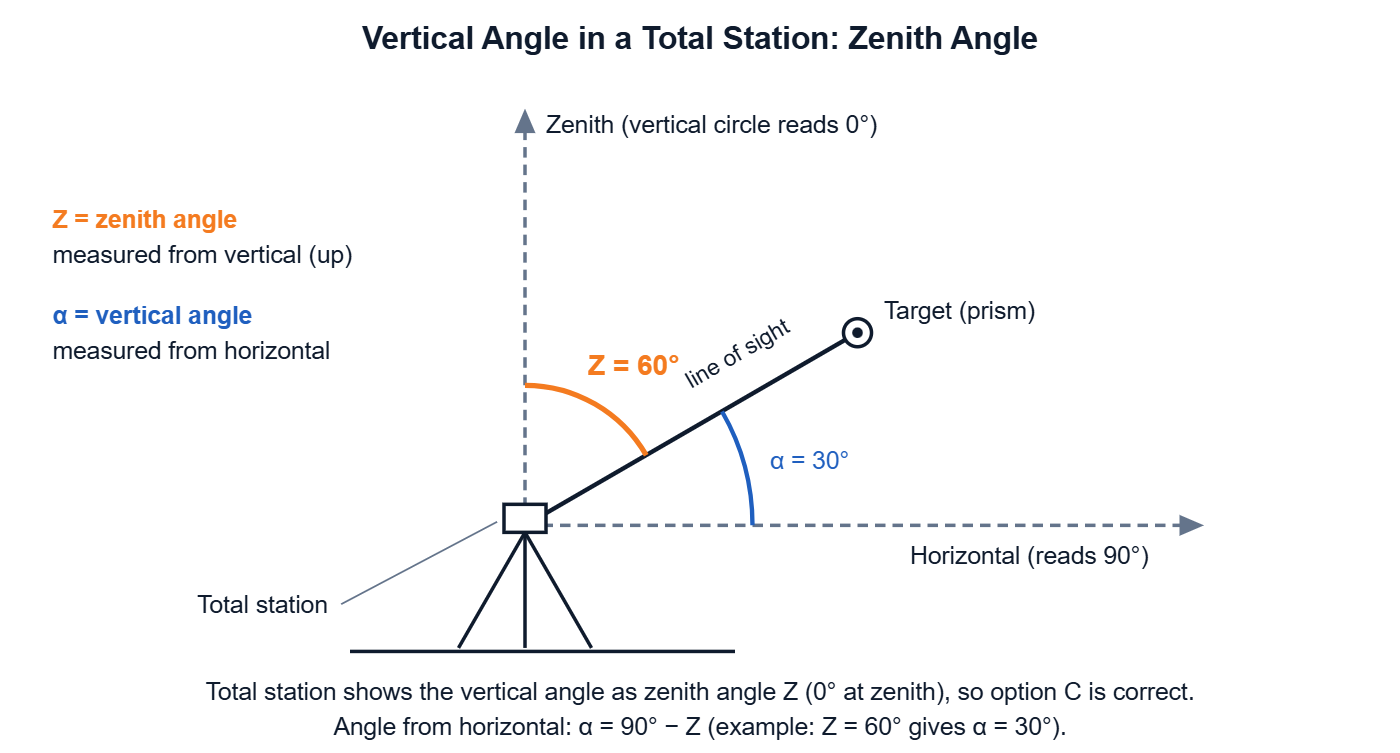
- CIt is usually measured as a zenith angle.Correct
- DIt is measured from the instrument north in the horizontal plane.
Solution
Concept
A total station measures vertical angles from the zenith (vertically upward direction), so it shows the zenith angle.
Formula
Vertical angle (from horizontal) = 90° − Zenith angle
Step-by-step solution
1. A total station has an electronic digital theodolite, so it can measure both horizontal and vertical angles. 2. In a total station, the vertical circle reads 0° when the telescope points straight up (zenith). 3. So the vertical angle is normally shown as a zenith angle. 4. If needed, the angle from horizontal is found as 90° − zenith angle. 5. So option C is correct.
Explanation
A total station usually measures the vertical angle from the zenith, which is the point straight above the instrument. This is called the zenith angle. A horizontal line of sight gives a zenith angle of 90°.
Why the other options are wrong
A: Wrong, an electronic digital theodolite can measure vertical angles. B: Measuring from the horizontal is possible, but it is not the usual default in a total station. D: Measuring from north in the horizontal plane gives an azimuth (a horizontal angle), not a vertical angle.
Shortcut
Total station vertical angle = zenith angle (0° straight up, 90° horizontal).
Common mistake
Students think the vertical angle is always measured from the horizontal, as in old transit theodolites.
Correct answer: C) It is usually measured as a zenith angle.