Which of the following statements regarding the vertical circle of a theodolite is correct?
- ABoth the graduation circle and the Vernier scale move with the telescope.
- BBoth the graduation circle and the Vernier scale are fixed, while the telescope moves.
- CThe graduation circle is fixed, but the Vernier scale moves with the telescope.
- DThe Vernier scale is fixed, but the graduation circle moves with the telescope.Correct
Solution
Concept
The vertical circle is fixed to the trunnion (horizontal) axis and turns with the telescope. The vernier on the index (T) frame stays fixed.
Step-by-step solution
1. The vertical circle is rigidly fixed to the horizontal (trunnion) axis of the telescope. 2. So when the telescope is raised or lowered, the vertical circle rotates with it. 3. The vernier C and D are on the index frame (T-frame), which does not move with the telescope. 4. So the vernier is fixed and the graduated circle moves with the telescope. Answer is (D).
Explanation
In a theodolite, the vertical circle is attached to the telescope axis, so it turns when the telescope moves up or down. The vernier scale is on the T-frame (index frame), which is kept fixed by the clip screw. So the vernier is fixed and the graduation circle moves.
Why the other options are wrong
A: The vernier does not move with the telescope; it is on the fixed index frame. B: The graduation circle is not fixed; it rotates with the telescope. C: This is reversed; the circle moves and the vernier is fixed.
Shortcut
Vertical circle moves with telescope; vertical vernier (T-frame) stays fixed. Horizontal circle is the opposite case.
Common mistake
Confusing it with the horizontal circle, where the vernier plate moves and the graduated circle can be clamped.
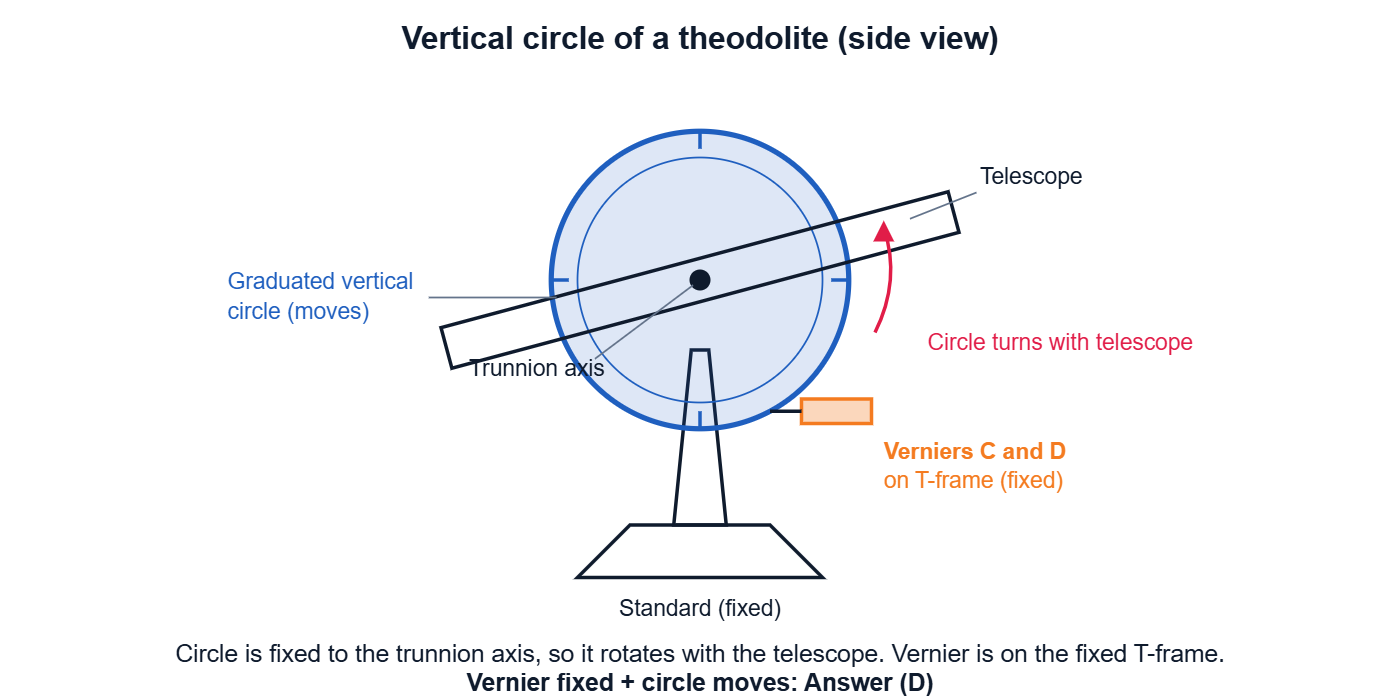
Correct answer: D) The Vernier scale is fixed, but the graduation circle moves with the telescope.