Which one of the following is an assumption made by Coulomb in the development of his earth pressure theory for sand and for active state?
- AThe rupture surface is non-uniform surface
- BThere is a wall friction on the pressure surfaceCorrect
- CFailure is three dimensional
- DThe soil is cohesive
Solution
Concept
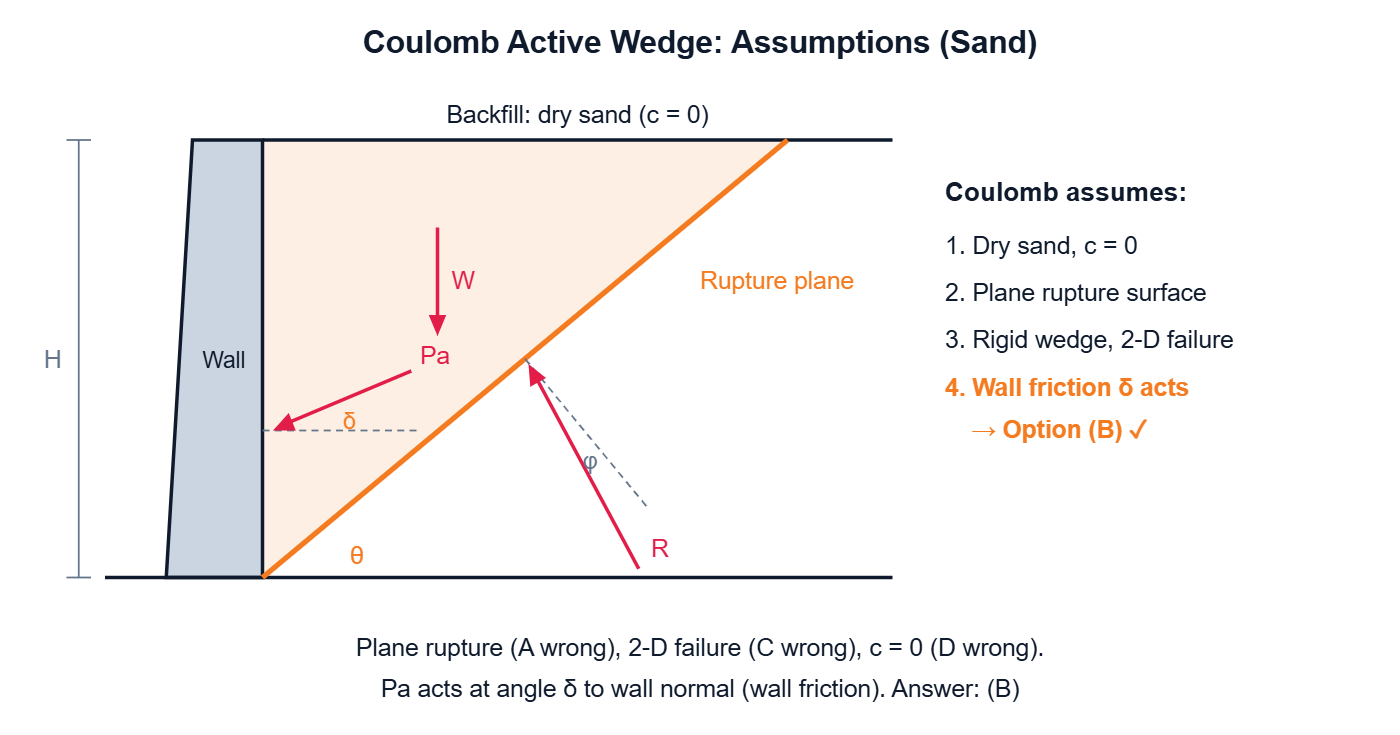
Coulomb's theory treats a plane sliding wedge of dry cohesionless soil and includes friction between the wall and the soil.
Step-by-step solution
1. List Coulomb's assumptions: soil is dry, homogeneous, isotropic and cohesionless. 2. The rupture surface is a plane. 3. The failure wedge is a rigid body, and the problem is two dimensional (plane strain). 4. Friction acts between the wall and the soil (wall friction δ). 5. Only option B matches. Answer is (B).
Explanation
Coulomb considered friction between the back of the wall and the soil. This is the main difference from Rankine's theory, which assumes a smooth wall. He also assumed a plane rupture surface, cohesionless soil and two-dimensional failure.
Why the other options are wrong
A: The rupture surface is assumed to be plane, not non-uniform. C: Failure is assumed two dimensional (plane strain). D: The soil is assumed cohesionless (sand).
Shortcut
Coulomb means wall friction plus a plane failure surface. Rankine means a smooth wall.
Common mistake
Mixing up Coulomb and Rankine, and thinking Coulomb assumed a smooth wall.
Correct answer: B) There is a wall friction on the pressure surface