Which one of the following statements is NOT correct?
- AFor structural steel, the rupture strength is higher than the ultimate strength.Correct
- BYield stress is the lowest stress at which extension of the test piece increases without further increase in load.
- CThe ultimate strength is commonly taken as the maximum stress of the material.
- DUltimate strength is the ratio of maximum load to the original cross sectional area.
Solution
Concept
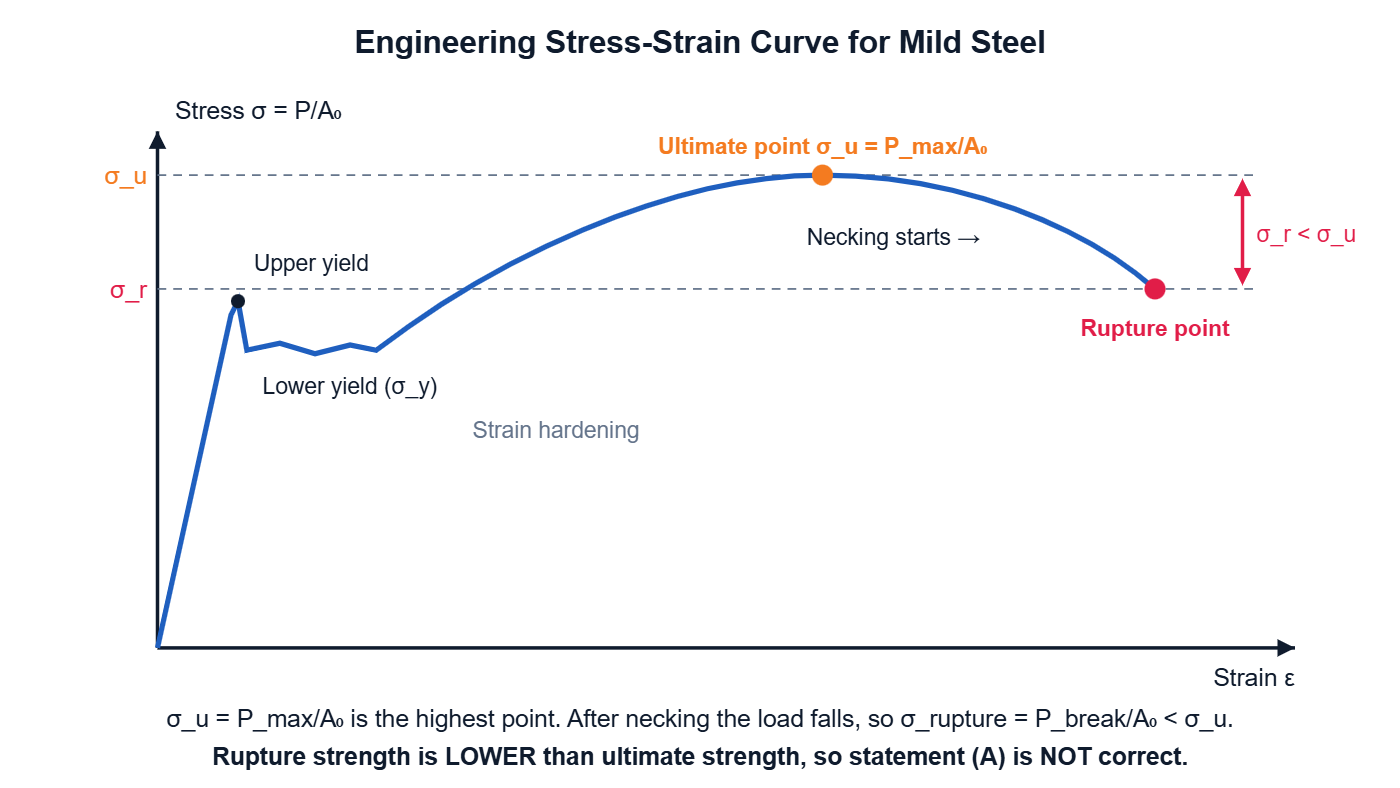
On the engineering stress-strain curve of steel, the ultimate stress is the highest point. The rupture (breaking) stress comes after necking and is lower.
Formula
σu = Pmax / A0
Step-by-step solution
1. Draw the engineering stress-strain curve for mild steel. 2. The curve rises to the maximum point. This is the ultimate stress, σu = Pmax/A0. 3. After this point necking starts and the load falls. 4. The bar breaks at a lower load, so the rupture stress (based on A0) is less than σu. 5. So statement A (rupture strength higher than ultimate strength) is NOT correct.
Explanation
For structural steel, the ultimate strength is the maximum stress on the curve. After necking, the load drops, so the rupture strength is lower than the ultimate strength. So statement A is wrong.
Why the other options are wrong
B: Correct. At yield point, extension increases without increase in load. C: Correct. Ultimate strength is the maximum stress the material can take. D: Correct. Ultimate stress = maximum load / original area.
Shortcut
Ultimate = peak of curve. Nothing (in engineering stress) is higher than the peak, so rupture < ultimate.
Common mistake
Using true stress (load / reduced neck area). True stress at rupture is higher, but standard definitions use the original area.
Correct answer: A) For structural steel, the rupture strength is higher than the ultimate strength.