Why are air vessels fitted in reciprocating pumps?
- AFor increasing the velocity of discharge
- BFor faster discharge
- CTo reduce the head loss due to friction in suction and delivery pipeCorrect
- DFor increasing the speed of rotation of the crank
Solution
Concept
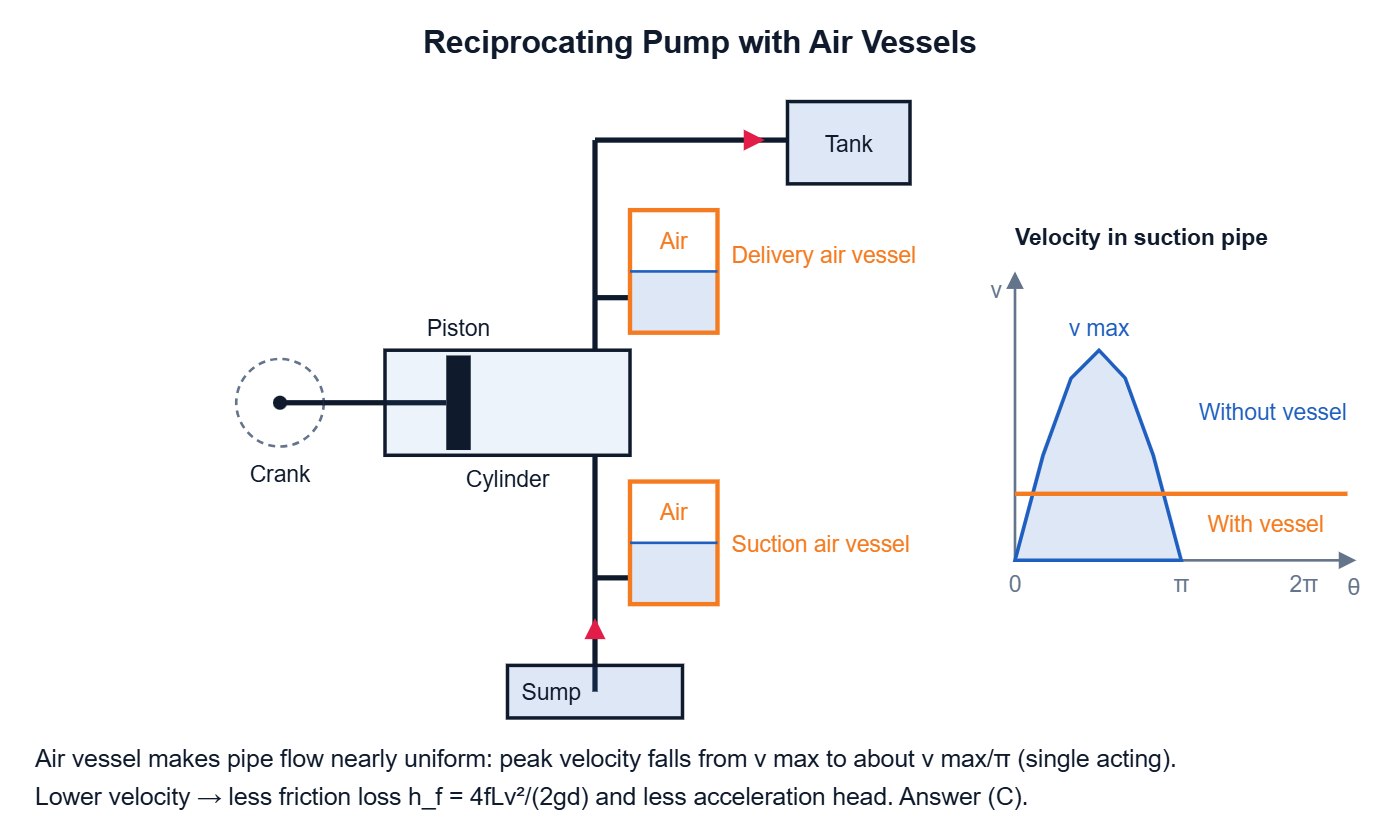
Air vessels make the flow in suction and delivery pipes nearly uniform. This reduces the acceleration head and the friction head loss.
Formula
hf = 4 f L V2 / (2 g d)
Step-by-step solution
1. In a reciprocating pump without air vessels, the flow in the pipes is unsteady and the velocity changes all the time. 2. An air vessel is a closed chamber with compressed air, fitted near the pump on the suction and delivery pipes. 3. It stores and releases water, so the flow in most of the pipe becomes almost uniform. 4. Uniform, lower peak velocity gives less friction head loss and less acceleration head. 5. This saves power, allows longer pipes or higher speed, and gives a uniform discharge.
Explanation
Air vessels make the flow in the suction and delivery pipes almost uniform. Because the velocity does not fluctuate, the friction head loss and the acceleration head are reduced. This saves work and power.
Why the other options are wrong
A: Air vessels do not increase the discharge velocity. They make the velocity uniform. B: They give a uniform discharge, not a faster one. D: Crank speed depends on the drive, not on air vessels.
Shortcut
Air vessel = uniform flow = less friction loss = power saving.
Common mistake
Thinking air vessels increase discharge or speed. They only smooth the flow and reduce losses.
Correct answer: C) To reduce the head loss due to friction in suction and delivery pipe