A rating curve at a stream gauging station represents a relationship between
- Adischarge and stage at a specific location on a stream, generally at the gauging stationCorrect
- Bvelocity and stage at a specific location on a stream, generally at the gauging station
- Cdischarge and velocity at a specific location on a stream, generally at the gauging station
- Dgauge height and critical velocity of a stream, generally at the gauging station
Solution
Concept
Stage-Discharge Rating Curve
Formula
Q = C(h + a)n
Step-by-step solution
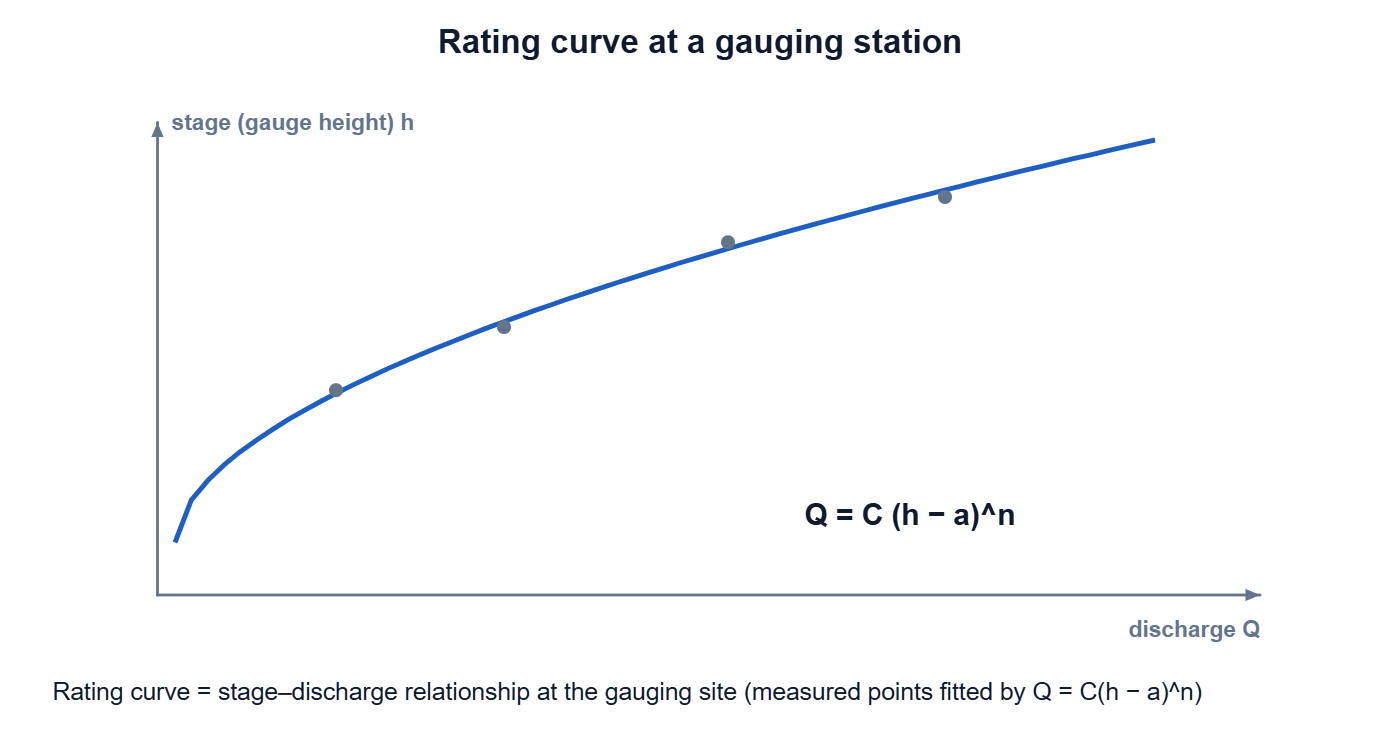
1. Review the given question about the relationship represented by a stream gauging rating curve. 2. Recall the rating curve formula Q = C(h + a)n, which relates stage or gauge height (h) to stream discharge (Q). 3. Compare with the given options and select Option (a) as the correct choice.
Explanation
A rating curve shows the direct relationship between the stage (water level height) and the discharge (total volume of water flowing per second) at a specific location along a stream or river. By measuring the water level at a gauging station, engineers can easily determine the river's flow rate using this curve.
Shortcut
To remember the rating curve relationship, use the mnemonic "Rating = Stage & Stream Flow": - Rating Curve = Stage vs. Discharge (Height vs. Flow Volume). - Memory Trick: "Rating measures how high (Stage) and how much (Discharge)".
Common mistake
A common mistake is selecting Option B or Option C by confusing a rating curve with a stage-velocity or discharge-velocity curve. Students often confuse stage with velocity or forget that a rating curve specifically plots stage (water surface elevation) against total discharge.
Correct answer: A) discharge and stage at a specific location on a stream, generally at the gauging station