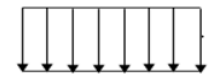
A rectangular shape of stress distribution diagram at the base of a circular chimney is shown in figure. By referring to it, it may be concluded that:
- Athe chimney is subjected to bending stress only
- Bthe chimney is subjected to wind pressure only
- Cthe chimney is subjected to direct compressive stress onlyCorrect
- Dthe chimney is subjected to both bending as well as direct compressive stress
Solution
Concept
A uniform (rectangular) stress diagram at the base means only direct axial stress acts, with no bending.
Formula
σ = P/A (uniform); with bending, σ = P/A ± M/Z
Step-by-step solution
1. The figure shows equal downward arrows across the full base, which is a rectangular diagram. 2. Direct stress σ = P/A is the same at every point, so it gives a rectangle. 3. Bending stress M/Z varies linearly across the base, so it would give a triangular or trapezoidal diagram. 4. There is no variation in the figure, so M = 0. 5. So only direct compressive stress acts: option C.
Explanation
Self weight gives uniform compressive stress P/A over the base. Wind gives a bending moment, which makes the stress vary from one edge to the other. Since the diagram is uniform, only direct compressive stress is present.
Why the other options are wrong
A: bending alone gives a triangular diagram with tension on one side and compression on the other. B: wind pressure causes bending, so the diagram would not be uniform. D: direct plus bending stress gives a trapezoidal or triangular diagram, not a rectangle.
Shortcut
Rectangle means direct stress only; trapezium means direct plus bending; triangle means e = D/8 limit or pure bending.
Common mistake
Assuming wind always acts on a chimney and choosing option D.
Correct answer: C) the chimney is subjected to direct compressive stress only