An I-section steel beam is connected to a steel column by means of two angles placed on two sides of the web of the beam. This type of connection is referred to as
- AStiffened seat connection
- BUn-stiffened seat connection
- CFramed connectionCorrect
- DRigid connection
Solution
Concept
Beam-to-column connections are classified based on their rotational stiffness and moment-transfer capacity. A framed connection uses two angles on the web of the beam to transfer shear with minimal moment restraint.
Step-by-step solution
1. Identify the components: An I-section steel beam, a steel column, and two angles placed on both sides of the beam's web. 2. Recognize the function: The angles connect the beam web to the column support, transmitting mainly shear force. 3. Match with standard terminology: This specific arrangement of double angles on the web is universally known as a framed connection (or web connection).
Explanation
A framed connection (or double-web angle connection) involves connecting the web of a beam to a column flange or web using two angle sections placed on either side of the beam web. This type of connection is primarily designed to transfer shear forces and is considered a flexible or pinned connection.
Why the other options are wrong
A: Stiffened seat connection uses a seat angle with a stiffener (plate or gusset) underneath. B: Un-stiffened seat connection uses only a seat angle without any stiffener. D: Rigid connection can transfer significant moments, usually involving flange welding or heavy moment plates.
Shortcut
Remember: Web angles = Framed connection; Seat angles at the bottom = Seat connection (stiffened or unstiffened).
Common mistake
Confusing a framed connection with a rigid connection, which typically involves both flange plates (or moment plates) and web angles to transfer significant moments.
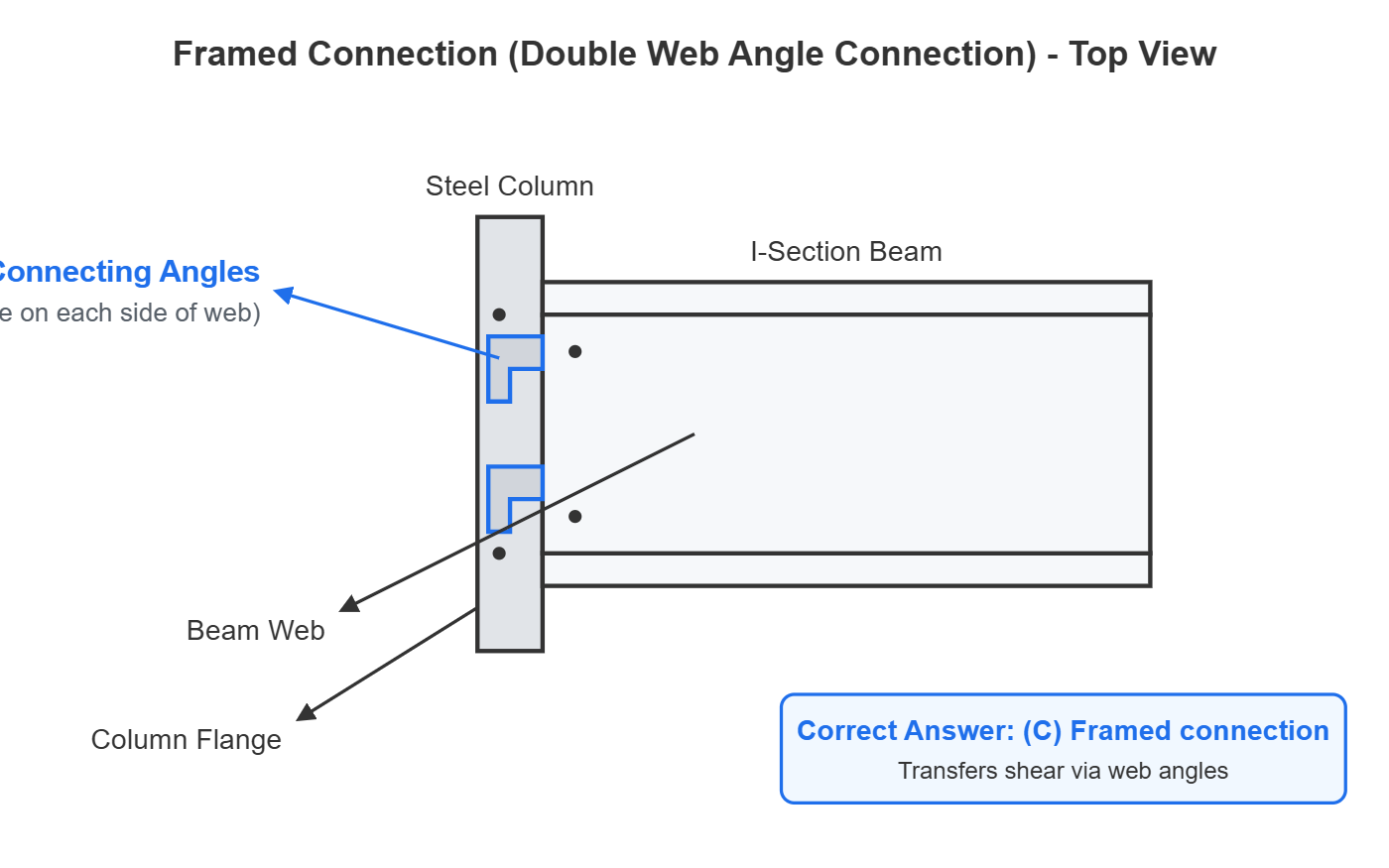
Correct answer: C) Framed connection