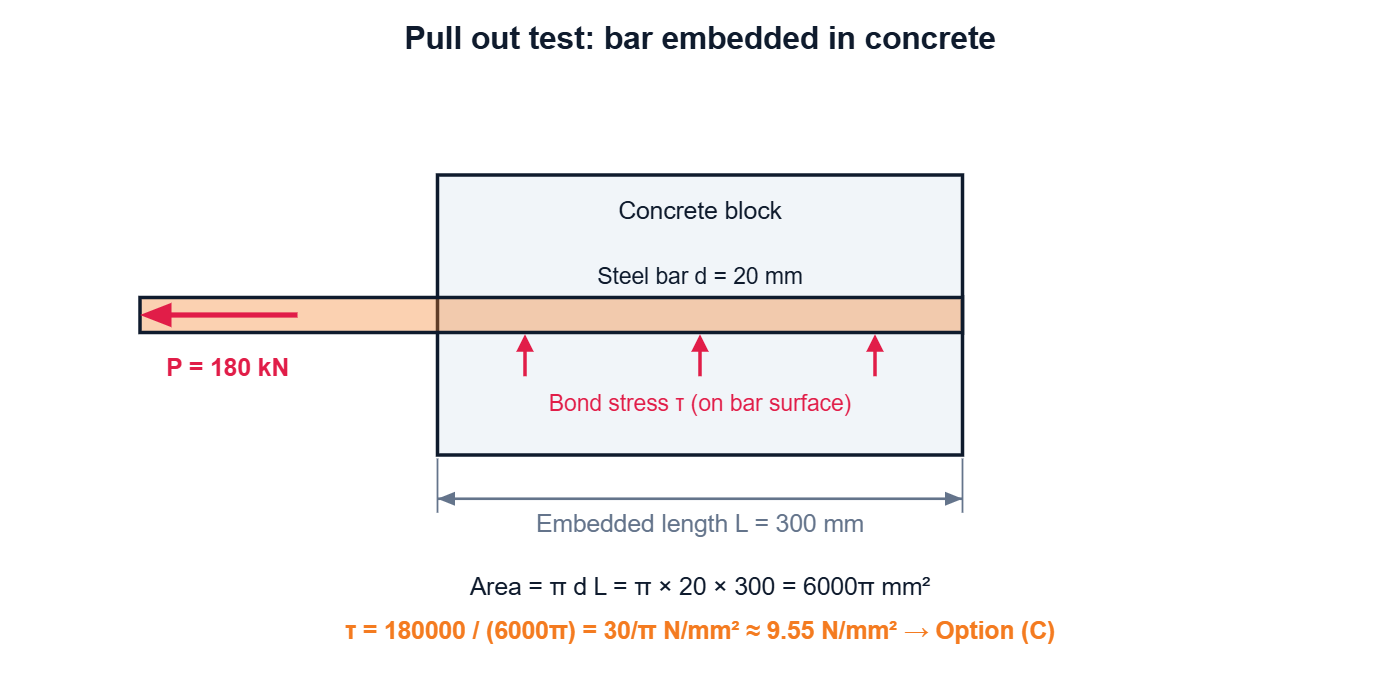
As per IS 2770 (Part 1), the load at failure in a pull out test was found to be 180 kN. Calculate the bond strength if the bar diameter is 20 mm and its embedded length into concrete is 300 mm.
- A50/π N/mm²
- B10/π N/mm²
- C30/π N/mm²Correct
- D15/π N/mm²
Solution
Concept
Bond strength is the failure load divided by the surface area of the bar in contact with concrete.
Formula
τbd = P / (π × d × L)
Step-by-step solution
1. Load at failure P = 180 kN = 180000 N 2. Bar diameter d = 20 mm, embedded length L = 300 mm 3. Contact area = π × d × L = π × 20 × 300 = 6000π mm² 4. Bond strength τbd = 180000 / (6000π) = 30/π N/mm² 5. 30/π ≈ 9.55 N/mm²
Explanation
In a pull-out test, the bar is pulled out of the concrete. The bond stress acts on the curved surface of the embedded bar. So bond strength = load / (π d L) = 30/π N/mm².
Why the other options are wrong
A (50/π): wrong arithmetic, it uses a larger load or a smaller area. B (10/π): wrong arithmetic, it uses a smaller load or a larger area. D (15/π): area taken double (for example, using 2πdL), so the answer is half.
Shortcut
180000 / (20 × 300) = 30, then divide by π.
Common mistake
Using the cross-sectional area πd²/4 instead of the surface area πdL.
Correct answer: C) 30/π N/mm²