Assertion (A): In a state of pure shear, the principal stresses are equal in magnitude but opposite in sign. Reason (R): On the Mohr’s circle for pure shear, the center coincides with the origin $(0,0)$. Choose the correct option: (A) Both (A) and (R) are correct and (R) is the correct explanation of
- ABoth (A) and (R) are correct and (R) is the correct explanation of (A)Correct
- BBoth (A) and (R) are correct, but (R) is not the correct explanation of (A)
- C(A) is correct but (R) is incorrect
- D(A) is incorrect but (R) is correct
Solution
Concept
Mohr's Circle for Pure Shear
Formula
N/A
Step-by-step solution
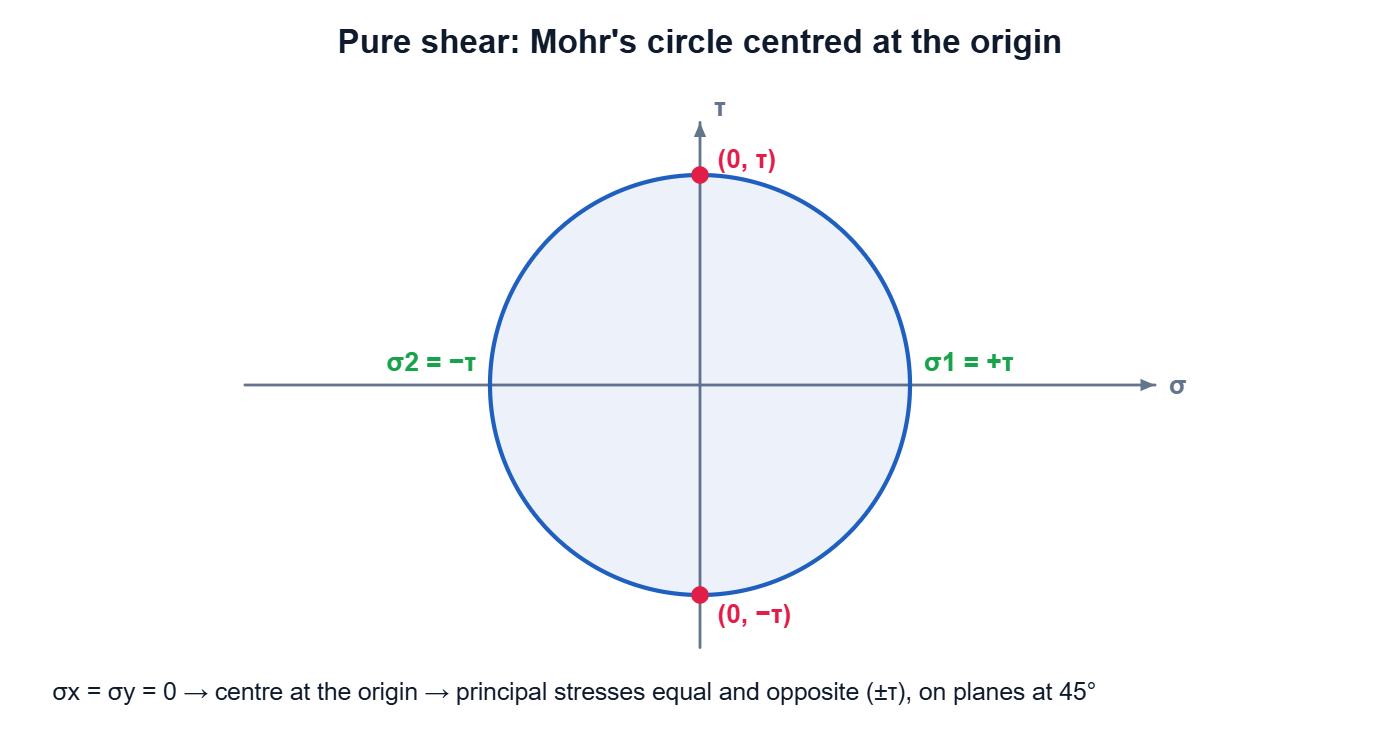
1. Analyze Assertion (A): In pure shear, principal stresses are equal in magnitude and opposite in sign (True). 2. Analyze Reason (R): In pure shear, average normal stress is zero, placing Mohr's circle center at the origin (0,0) (True). 3. Note that having the center at the origin directly explains why principal stresses are equal in magnitude and opposite in sign (+R and -R). 4. Select Option (a) as the correct choice.
Shortcut
To remember Mohr's circle for Pure Shear, use the rule "Center at Origin = Symmetric Stresses": - Center at (0,0): Average normal stress is zero, placing the circle center right at the origin. - Equal & Opposite: Radius R extends equally to the left (-R) and right (+R), making principal stresses equal in magnitude and opposite in sign.
Common mistake
A common mistake is selecting Option B by believing that Reason (R) is true but not the correct explanation for Assertion (A). Students often miss that because the center of Mohr's circle sits at the origin (0,0), the principal stresses are symmetrically positioned at +R and -R from the origin, directly explaining why they are equal in magnitude and opposite in sign.
Correct answer: A) Both (A) and (R) are correct and (R) is the correct explanation of (A)