Compression index is obtained from which compression curve?
- Ae-p′
- Be-log p′Correct
- Cε -p′
- Dε -log p′
Solution
Concept
Compression Index
Formula
Cc = (e1 - e2) / log10(p2' / p1')
Step-by-step solution
1. Plot the void ratio (e) on the vertical axis and effective stress/pressure (p') on a logarithmic scale on the horizontal axis (e vs log p'). 2. Identify two points on the linear section of the curve: (e1, p1') and (e2, p2'). 3. Calculate the change in void ratio: Δe = e1 - e2. 4. Calculate the log of the ratio of effective stresses: log10(p2' / p1'). 5. Divide the change in void ratio by the logarithmic stress ratio to find the compression index: Cc = (e1 - e2) / log10(p2' / p1').
Explanation
The compression index measures how much a soil compresses under pressure. When you plot the void ratio (e) against the logarithm of effective pressure (log p′), the steep straight-line portion of this curve represents the compression index, as its slope directly gives this value.
Shortcut
Remember "Cc" (Compression Index) uses "log" for the pressure scale: e vs log p′ (Void ratio vs Logarithm of effective pressure).
Common mistake
Many students confuse the arithmetic plot of void ratio versus effective pressure (e-p′) with the semi-logarithmic plot (e-log p′), accidentally selecting option A instead of remembering that the compression index (Cc) is defined as the slope of the linear portion of the e versus log p′ curve.
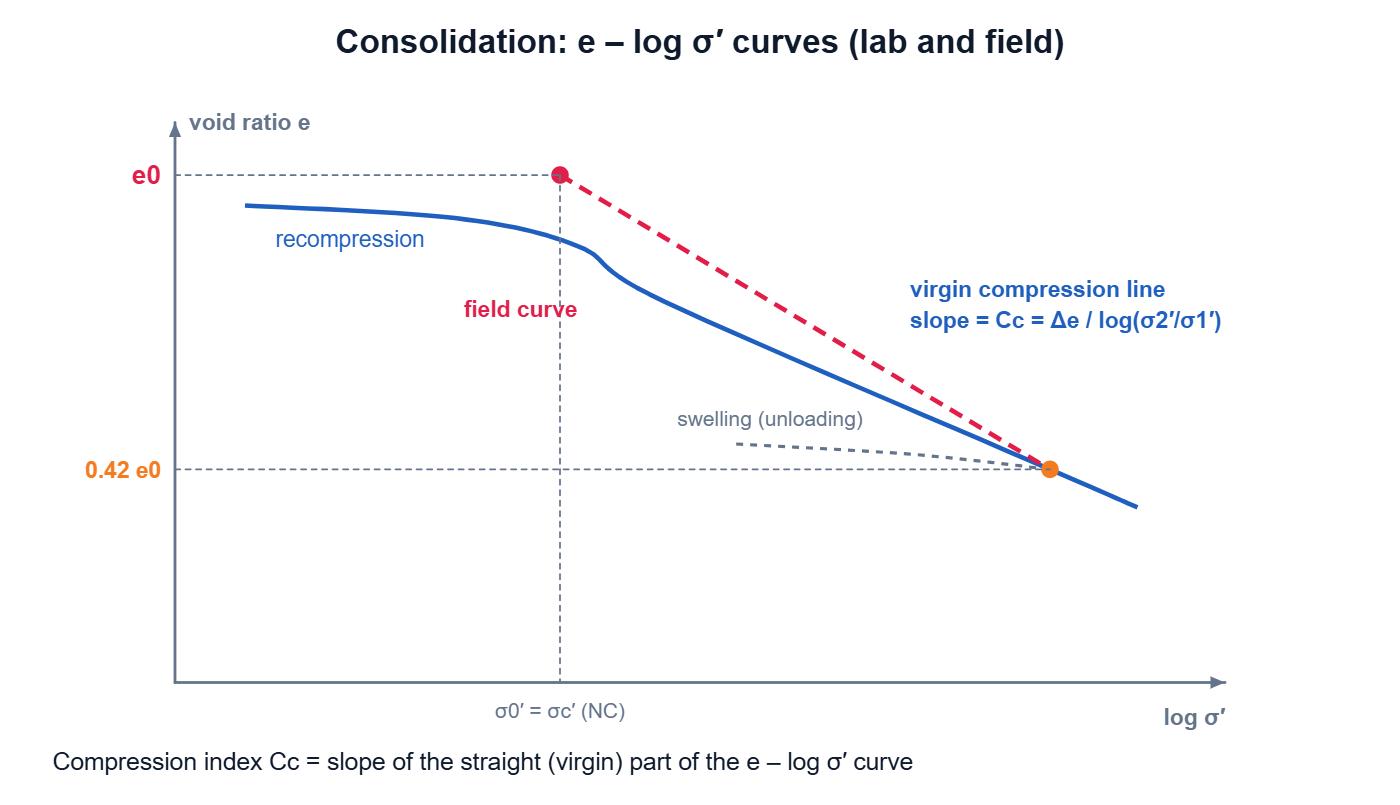
Correct answer: B) e-log p′