For estimating primary consolidation of a NC clay slope, which of the following curves should be used?
- Arecompression curve
- Bvirgin compression curveCorrect
- Cswelling curve
- Dnone of the above
Solution
Concept
Primary Consolidation of Normally Consolidated Clay
Formula
Sc = (Cc × H / (1 + e0)) × log10((σ0' + Δσ') / σ0')
Step-by-step solution
- Identify the given values: initial void ratio (e0), layer thickness (H), compression index (Cc), initial effective stress (σ0'), and stress increase (Δσ') - Calculate the final effective stress by adding the stress increase to the initial stress: σf' = σ0' + Δσ' - Compute the stress ratio (σf' / σ0') and find its logarithm: log10(σf' / σ0') - Multiply (Cc × H / (1 + e0)) by the log result to obtain primary consolidation settlement (Sc)
Explanation
For a normally consolidated (NC) clay, the soil has never experienced a higher effective stress in its past history than its current level. Therefore, when additional load is applied, the relationship between void ratio and effective stress directly follows the virgin compression curve to calculate primary consolidation settlement.
Shortcut
NC Clay = Virgin Compression Curve Shortcut: Think of "NC" as "New Clay" or "Never Compressed before" — since it is experiencing maximum stress for the first time, it always follows the Virgin compression curve.
Common mistake
Many students confuse normally consolidated (NC) clay with overconsolidated (OC) clay and incorrectly select the recompression curve instead of the virgin compression curve.
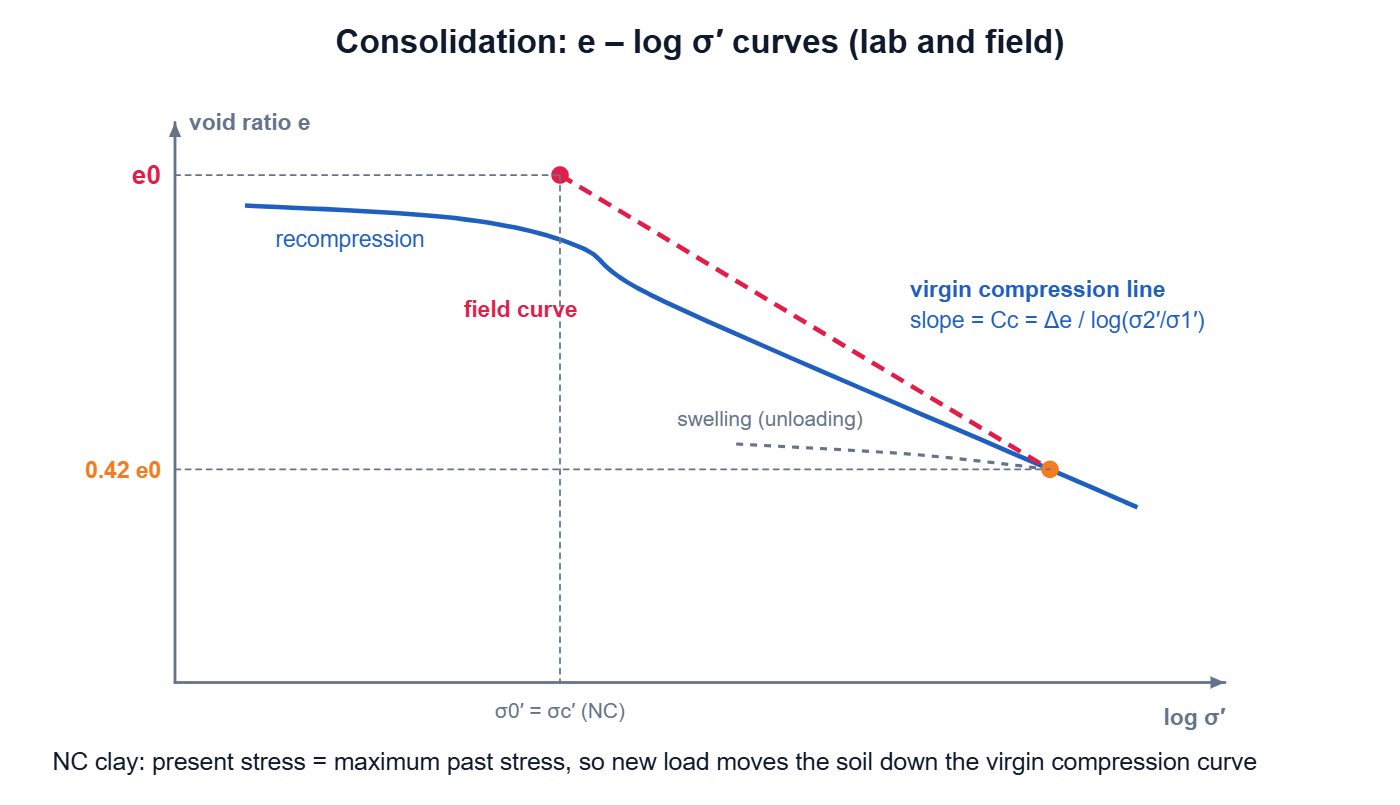
Correct answer: B) virgin compression curve