Consider the two bamboo beams, with similar flexural stiffness EI, as shown in the figure 1 and figure 2 below; consider that the maximum deflection and rotation in case of Beam 1 is δmax1 and θmax1, whereas for Beam 2 is δmax2 and θmax2. On the principles of slope and deflection theory, which of the following describes a correct relationship between the two beams? (Beam 1: span L, fixed at one end with roller at the other, UDL; Beam 2: two spans of L, each fixed at its outer end and joined by a hinge, UDL)
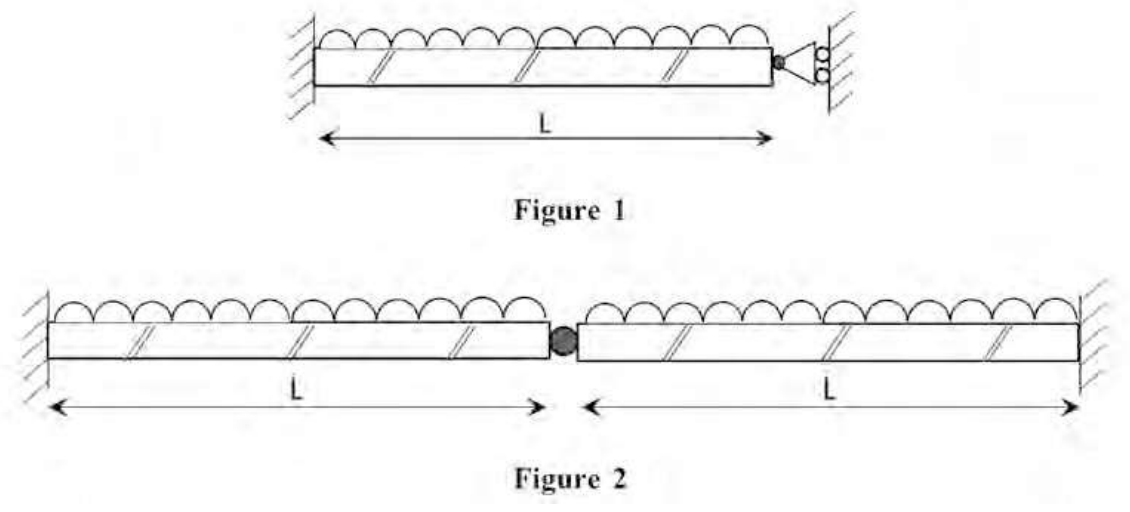
- Aδmax1 = δmax2 and θmax1 ≠ θmax2
- Bδmax1 ≠ δmax2 and θmax1 = θmax2
- Cδmax1 = δmax2 and θmax1 = θmax2Correct
- Dδmax1 ≠ δmax2 and θmax1 ≠ θmax2
Solution
Concept
Equivalent beams
Step-by-step solution
1. Analysis of Beam 1 • Boundary Conditions: The left end is securely fixed. The right end features a roller support against a vertical wall. • Behavior under Vertical Loading (UDL): Because the rollers can slide vertically along the wall, this support cannot provide any vertical reaction force (Ry = 0). Being a roller, it also cannot resist any bending moment (M = 0). • Conclusion: For a purely vertical uniformly distributed load (UDL), Beam 1 behaves exactly like a standard cantilever beam of length (L). • (δmax1 = (wL4)/(8EI)) (at the free roller end) • (θmax1 = (wL3)/(6EI)) (at the free roller end) 2. Analysis of Beam 2 • Symmetry: The structure, support conditions (both outer ends fixed), and the UDL loading are completely symmetric about the central internal hinge. • Internal Forces at the Hinge: • By definition, an internal hinge cannot transmit any bending moment (Mhinge = 0). • Due to the perfect symmetry of the load and geometry, the internal shear force transferred through the hinge must also be zero (Vhinge = 0). Conclusion: Since M = 0 and V = 0 at the center, the internal hinge acts exactly like a free end. This splits Beam 2 into two independent halves, each behaving precisely like a cantilever beam of length L.• δmax2 = (wL4)/(8EI) (at the central hinge) • θmax2 = (wL3)/(6EI) (at the central hinge)
Explanation
Since both structural configurations simplify to the exact same cantilever behavior under the given loading: • δmax1 = δ
Correct answer: C) δmax1 = δmax2 and θmax1 = θmax2