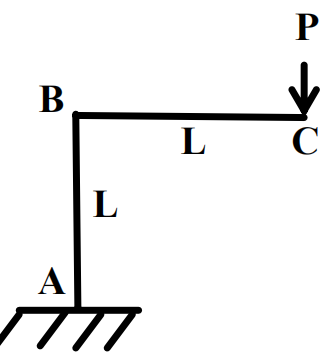
What is the horizontal deflection at free end C of the frame shown in the figure? EI is flexural rigidity of both the members.
- APL³ / 3EI
- BPL³ / 2EICorrect
- CPL² / 3EI
- DPL² / 2EI
Solution
Concept
Deflection of Frames
Formula
δ = PL³ / 2EI
Step-by-step solution
1. Find the bending moment in column AB caused by load P at C: M = P × L. 2. Apply the deflection formula for a cantilever column under constant moment M: δ = M × L² / (2EI). 3. Substitute M = P × L to get horizontal deflection: δ = (P × L) × L² / (2EI) = PL³ / 2EI.
Explanation
Option B (PL³ / 2EI) is correct because the vertical load P at end C creates a constant bending moment of M = P × L throughout the vertical column AB. This bending moment causes column AB to curve and tip horizontally at joint B. Using the standard deflection formula for a cantilever subjected to a constant moment M over length L (δ = ML² / 2EI), substituting M = PL gives a horizontal deflection of (PL × L²) / 2EI = PL³ / 2EI at the top joint B, which transfers directly as the horizontal deflection at free end C.
Shortcut
Remember: Load P at free end C creates a constant bending moment M = P × L on vertical member AB. Using the standard formula for deflection under a constant moment (δ = ML² / 2EI), substitute M = PL to get δ = PL³ / 2EI.
Common mistake
Students often confuse the loading on member AB as a direct point load P rather than a constant bending moment M = PL, leading them to select Option A (PL³/3EI) based on the standard cantilever deflection formula for a point load instead of the constant moment formula (PL³/2EI).
Correct answer: B) PL³ / 2EI