In case of lintel design, the load enclosed in an equilateral triangle is fully transferred to the lintel provided the height of wall above lintel is
- Anot less than 1.25 times the height of equilateral triangleCorrect
- Bless than twice the height of equilateral triangle
- Cless than 1.25 times the height of equilateral triangle
- Dgreater than twice the height of equilateral triangle
Solution
Concept
Load transfer criteria in lintel design
Formula
NONE
Step-by-step solution
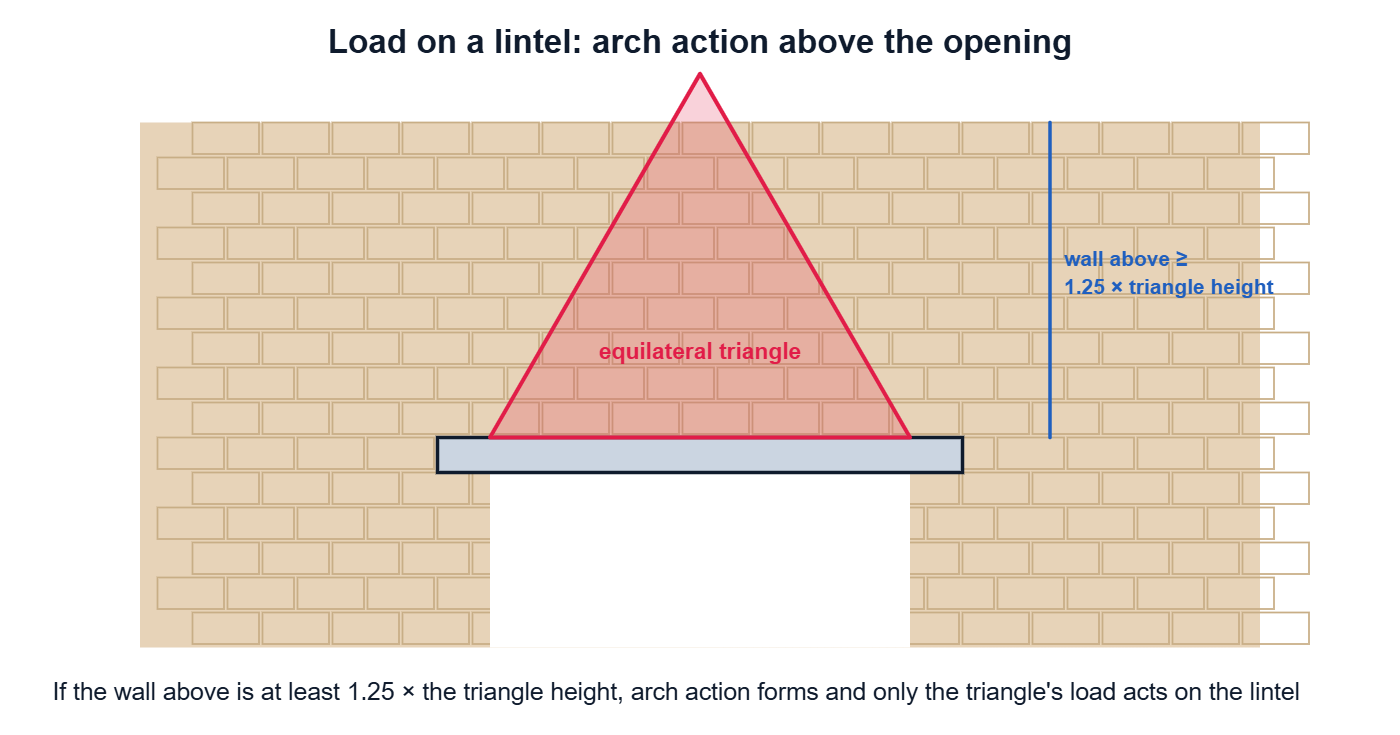
1. Masonry arch action develops above a lintel opening if sufficient height of wall masonry is present above it. 2. The load of masonry within an equilateral triangle of side equal to effective span is considered to act on the lintel. 3. Arching action fully forms only when the height of wall above the lintel is at least 1.25 times the height of this equilateral triangle. Answer: A
Explanation
When masonry is built over a lintel, arching action helps relieve part of the wall weight from directly loading the beam. For the full triangular weight of the masonry to act on the lintel, the wall height above it must be sufficient for arching to develop. This condition requires the wall height above the lintel to be not less than 1.25 times the height of the load triangle.
Why the other options are wrong
B) Heights under twice the triangle height do not guarantee full load transfer via arching action. C) If the wall height is below 1.25 times the triangle height, complete arching action cannot develop. D) Requiring more than twice the height is an overly conservative condition for triangular load transfer.
Shortcut
Full triangular load transfers to lintel if wall height ≥ 1.25 × triangle height.
Common mistake
Confusing "not less than" with "less than" regarding the required wall height above the lintel.
Correct answer: A) not less than 1.25 times the height of equilateral triangle