Independent float is defined as :
- AMaximum amount of time by which an activity can be delayed from early start without delaying the project.
- BMaximum amount of time by which an activity can be delayed without delaying the early start of any following activity.
- CMaximum amount of time by which an activity can be delayed without delaying the project but will cause delay to the early start of some following activity.
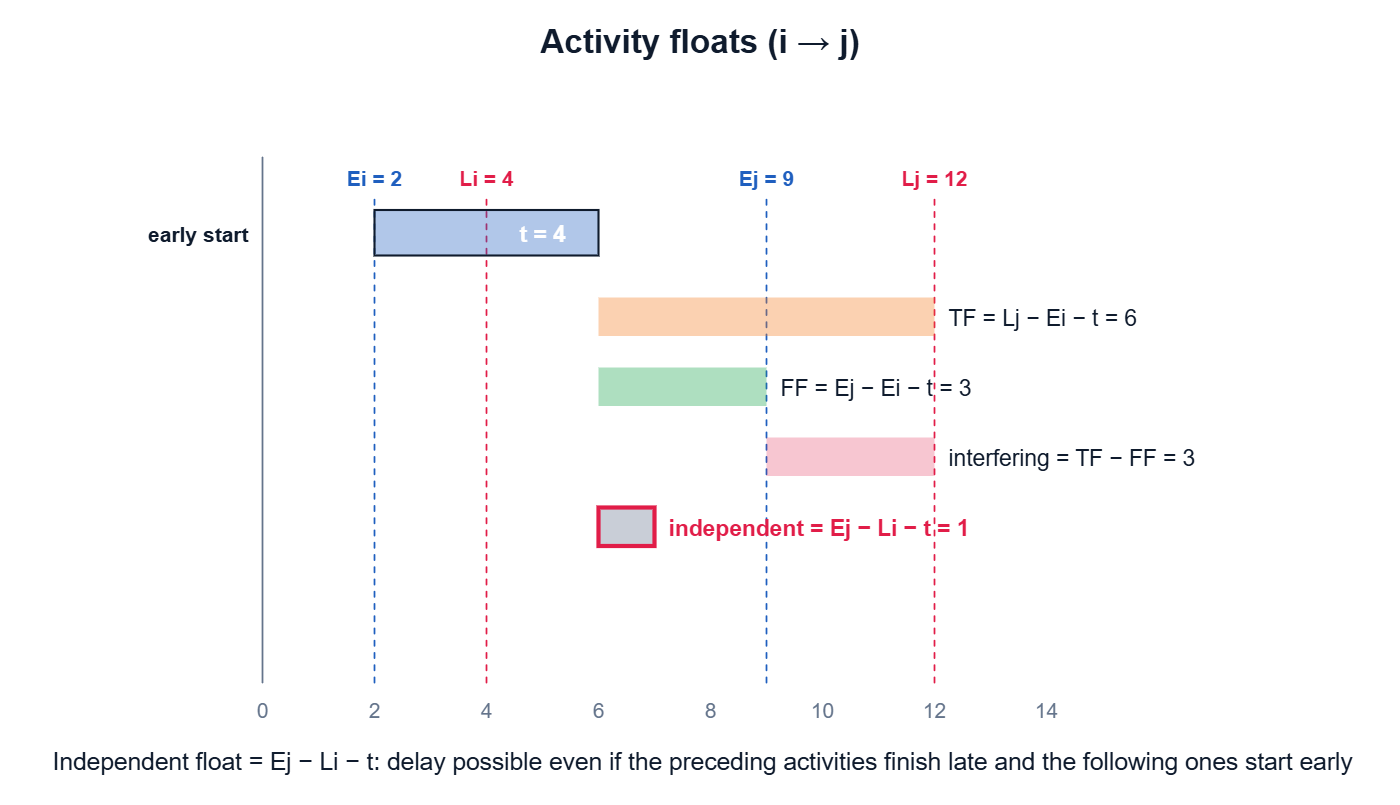
- DMaximum amount of time by which an activity can be delayed without delaying the project; even if all predecessors are at late start and all successors at early start.Correct
Solution
Concept
Types of float
Formula
IF = max(0, Ej − Li − D)
Step-by-step solution
1. Total float: delay from early start without delaying the project (a). 2. Free float: delay without delaying the early start of any following activity (b). 3. Interfering float: the part of the total float that affects following activities (c). 4. Independent float: delay available even in the worst case where all predecessors are late and all successors are early (d).
Explanation
Independent float is the most conservative float. It is the spare time that remains for an activity if its predecessors finish as late as possible and its successors start as early as possible.
Why the other options are wrong
(a) is total float, (b) is free float and (c) describes interfering float.
Shortcut
TF ≥ FF ≥ IF.
Common mistake
Confusing independent float with free float.
Correct answer: D) Maximum amount of time by which an activity can be delayed without delaying the project; even if all predecessors are at late start and all successors at early start.