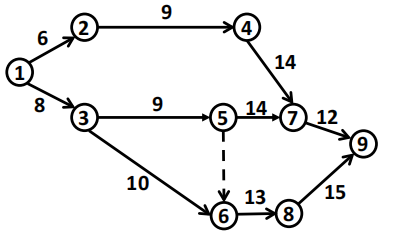
The flow net of activities of a project is given in the following figure. The duration of activities are indicated along the arrows. The critical path of the activities is along
- A1-2-4-7-9
- B1-3-5-7-9
- C1-3-6-8-9Correct
- D1-3-5-6-8-9
Solution
Concept
Critical Path in Network Analysis
Formula
No specific mathematical formula exists; it is determined by finding the path with zero total float (Total Float = Latest Start - Earliest Start = 0) using forward and backward pass calculations.
Step-by-step solution
- Perform a forward pass to calculate the Earliest Start (ES) and Earliest Finish (EF) times for each activity starting from node 1 to node 9. - Perform a backward pass from node 9 to node 1 to calculate the Latest Finish (LF) and Latest Start (LS) times for each activity. - Calculate the Total Float for each activity using the formula: Total Float = LS - ES. - Identify the sequence of connected activities where the Total Float equals zero; this longest duration sequence forms the critical path (1-3-6-8-9).
Explanation
The critical path is the longest continuous sequence of activities from the start node (1) to the end node (9) in a network diagram. Path 1-3-6-8-9 represents the sequence of dependent tasks that takes the maximum total time to complete, which determines the minimum time required to finish the entire project.
Shortcut
Calculate the sum of activity durations along each path from start to end node; the path with the longest total duration is the critical path.
Common mistake
A common mistake is choosing the path with the fewest number of activities or nodes rather than calculating the total duration along every possible path to find the longest one. Students also frequently overlook intermediate activity durations or dummy activities when summing path times.
Correct answer: C) 1-3-6-8-9