Statement (I): Any orthogonal set of axes are 180° to one another on Mohr's circle. Statement (II): The distance between these axes is half the diameter of the circle.
- ABoth Statement (I) and Statement (II) are individually true and Statement (II) is the correct explanation of Statement (I)
- BBoth Statement (I) and Statement (II) are individually true but Statement (II) is not the correct explanation of Statement (I)
- CStatement (I) is true but Statement (II) is falseCorrect
- DStatement (I) is false but Statement (II) is true
Solution
Concept
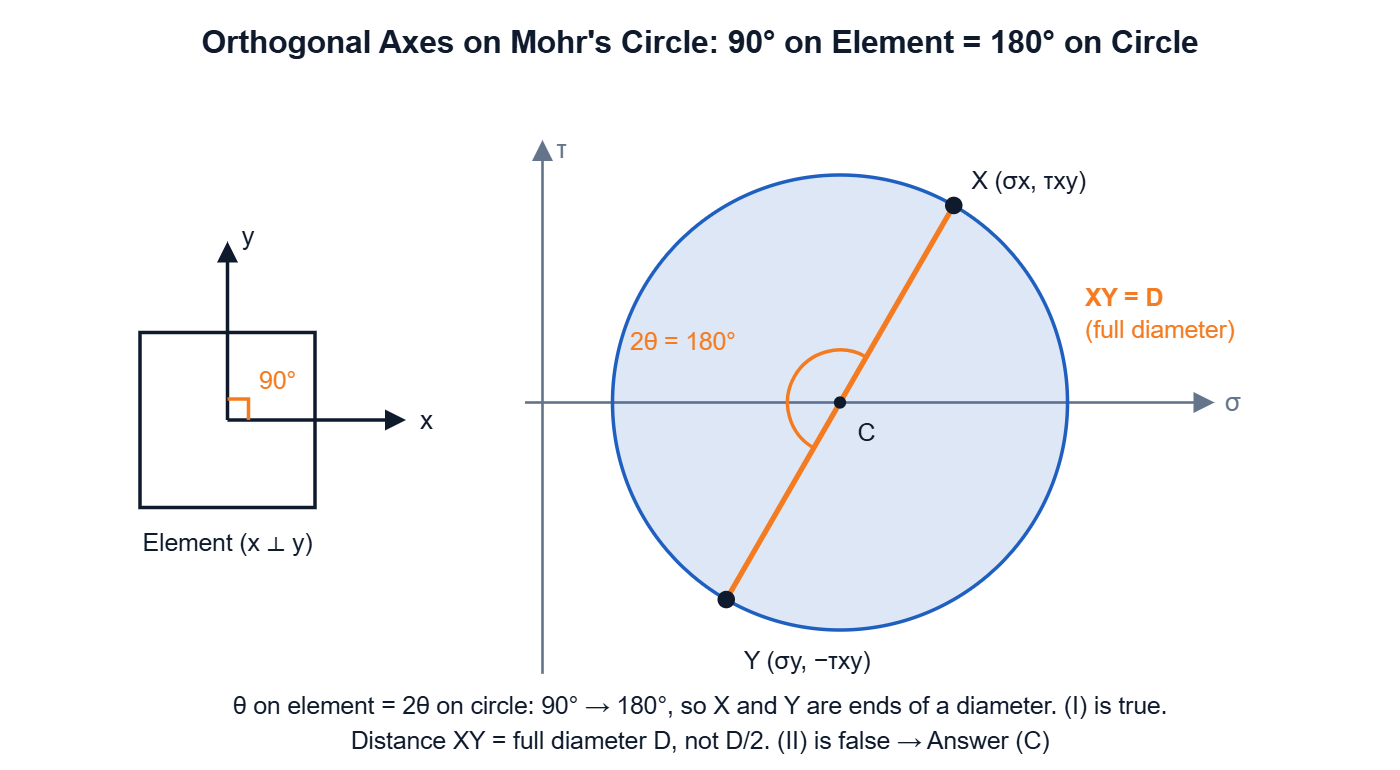
An angle θ on the element appears as 2θ on Mohr's circle, so perpendicular planes are 180° apart on the circle.
Formula
Angle on Mohr's circle = 2θ; for θ = 90°, 2θ = 180°
Step-by-step solution
1. On Mohr's circle, a rotation θ on the real element becomes 2θ on the circle. 2. Orthogonal axes are 90° apart. On the circle they are 2 × 90° = 180° apart. So (I) is true. 3. Two points 180° apart lie at the two ends of a diameter. 4. So the distance between them is the full diameter, not half the diameter. (II) is false. 5. Answer is option C.
Explanation
Mohr's circle doubles the angle, so planes at 90° appear 180° apart. Points 180° apart on a circle are at the two ends of a diameter. So the distance between them is one full diameter, and Statement (II) is false.
Why the other options are wrong
A and B: Statement (II) is false, because the distance is a full diameter, not half. D: Statement (I) is true, not false.
Shortcut
90° on element = 180° on circle = opposite ends of a diameter.
Common mistake
Forgetting the factor 2 and thinking orthogonal planes are 90° apart on Mohr's circle.
Correct answer: C) Statement (I) is true but Statement (II) is false