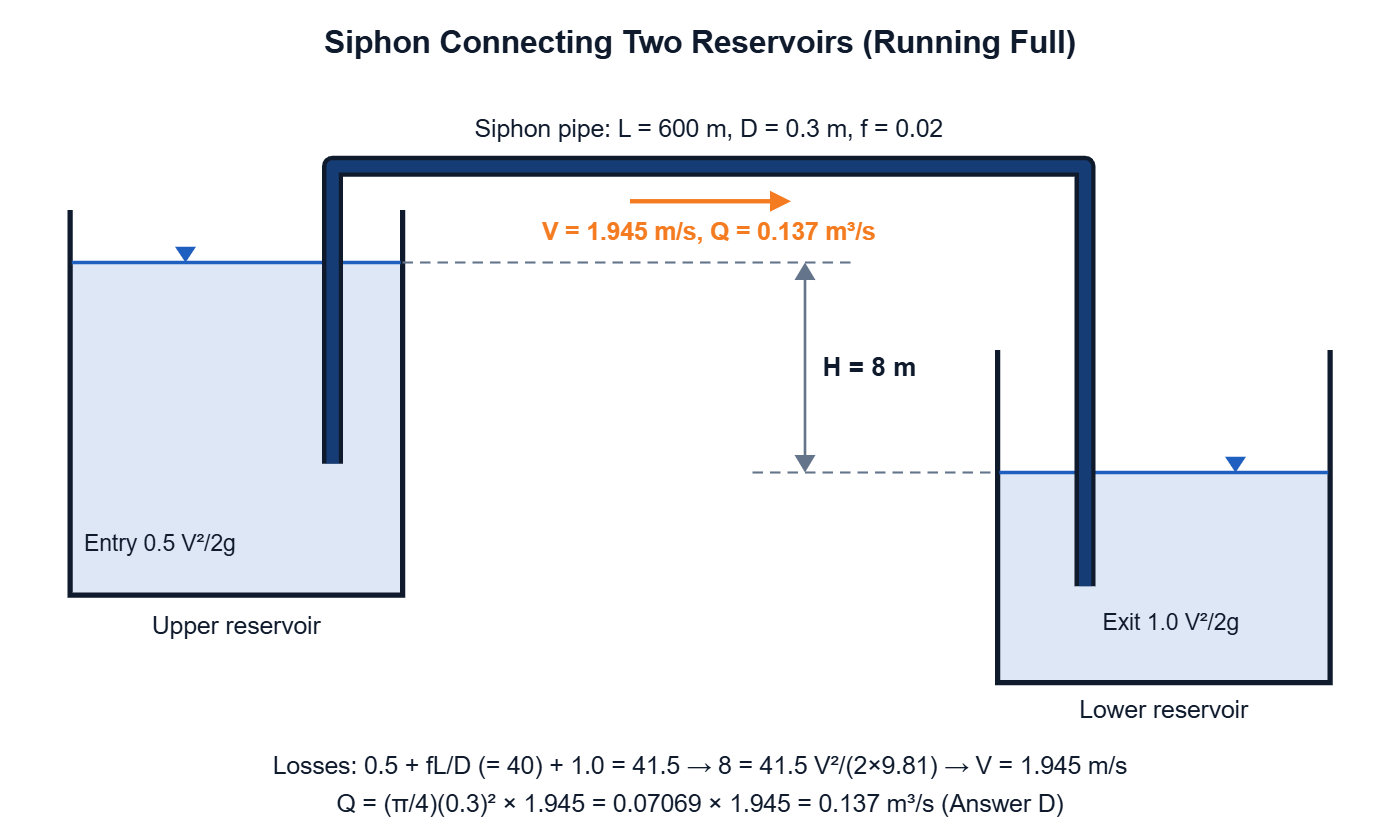
The difference in the water surface level of two reservoirs which are connected by a siphon is 8 m. The length of siphon is 600 m and its diameter 0.3 m. If the siphon is running full, then what is the discharge? (Take f = 0.02)
- A3.242 m³/s
- B2.117 m³/s
- C1.842 m³/s
- D0.137 m³/sCorrect
Solution
Concept
The head difference between the two reservoirs equals the entry loss plus the friction loss plus the exit loss.
Formula
H = (V2/(2g)) × (0.5 + fL/D + 1); Q = (π/4) × D2 × V
Step-by-step solution
1. Data: H = 8 m, L = 600 m, D = 0.3 m, f = 0.02 (Darcy). 2. fL/D = 0.02 × 600/0.3 = 40. 3. Total loss coefficient = 0.5 (entry) + 40 (friction) + 1.0 (exit) = 41.5. 4. 8 = 41.5 × V2/(2 × 9.81), so V2 = 156.96/41.5 = 3.782 and V = 1.945 m/s. 5. Area A = (π/4) × 0.32 = 0.07069 m². 6. Q = 0.07069 × 1.945 = 0.137 m³/s.
Explanation
The water level difference is used up by the entry loss, the pipe friction loss and the exit loss. Solving for velocity gives V = 1.945 m/s. Discharge = area × velocity = 0.137 m³/s.
Why the other options are wrong
A, B and C are far too large. A 0.3 m pipe that is 600 m long cannot carry 1.8 to 3.2 m³/s under only 8 m of head. These values would need impossible velocities (about 26 to 46 m/s).
Shortcut
If you take only the friction loss, Q ≈ 0.140 m³/s, which is already closest to option D.
Common mistake
Using 4f instead of f (this gives Q ≈ 0.070 m³/s), or forgetting the entry and exit losses.
Correct answer: D) 0.137 m³/s