The nominal thickness of a boundary layer is generally considered as the distance from the wall to the point where the flow velocity is
- A50% of the free stream velocity.
- B90% of the free stream velocity.
- C99% of the free stream velocity.Correct
- D100% of the free stream velocity.
Solution
Concept
Boundary Layer Thickness
Formula
Yes, for a laminar boundary layer over a flat plate, the formula is δ = 5.0 × x / √(Rex). For a turbulent boundary layer, it is approximately δ = 0.37 × x / (Rex)0.2.
Step-by-step solution
1. Identify the standard definition: Boundary layer thickness (δ) is the distance from the wall where local velocity reaches 99% of free stream velocity (u = 0.99 U). 2. Match with given options: Option C corresponds to 99% of the free stream velocity. 3. Select Option C as the correct answer.
Explanation
The boundary layer thickness is defined as the distance from a solid surface to the point where the fluid velocity reaches 99% of the undisturbed free stream velocity. Beyond this point, the effect of surface friction is considered negligible.
Shortcut
Remember "Boundary = 99%": Boundary layer edge is where velocity reaches 99% (0.99) of free stream velocity.
Common mistake
Many students mistakenly choose 100% of the free stream velocity (Option D), assuming the boundary layer extends to where the flow reaches full velocity. However, because velocity approaches the free stream speed asymptotically, the nominal thickness is defined at 99% (Option C).
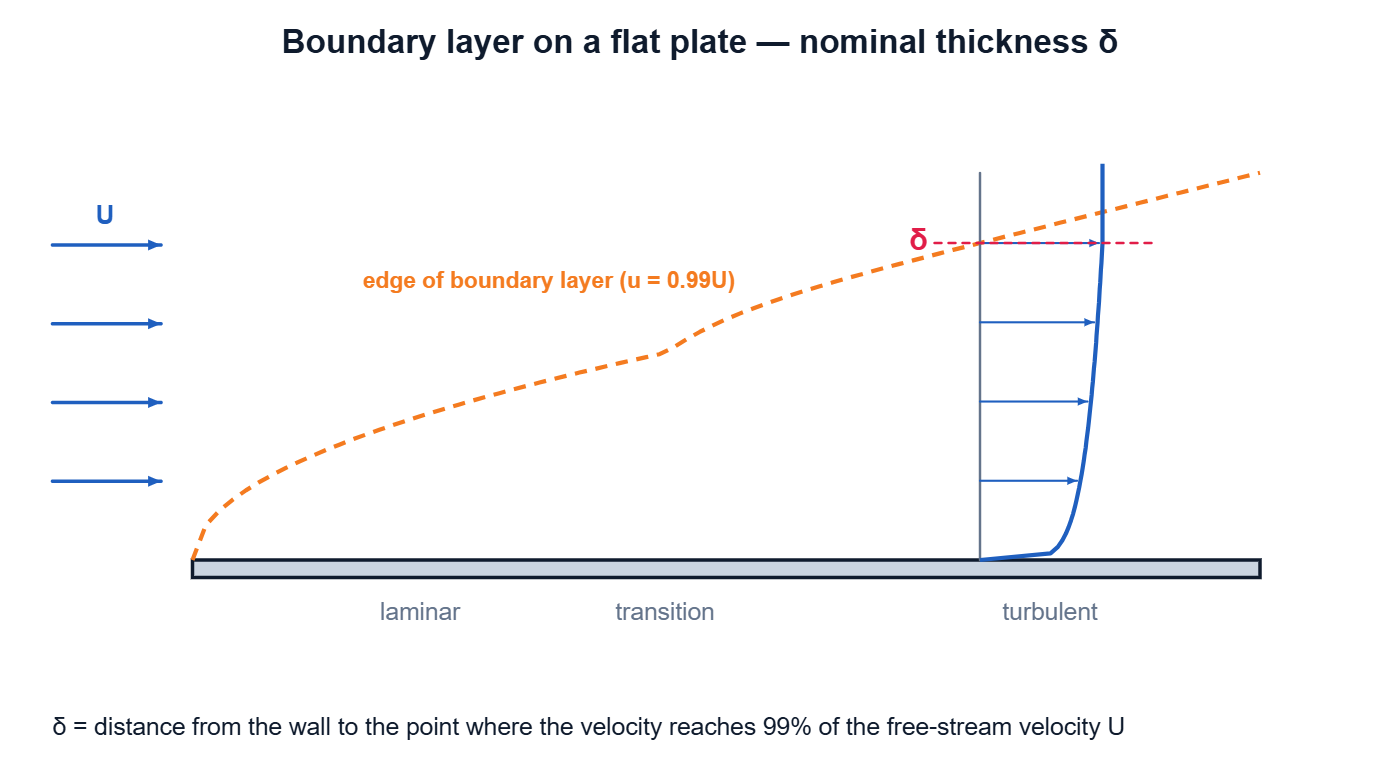
Correct answer: C) 99% of the free stream velocity.